Your cart is currently empty!
+86 15863276370

Keeping poultry houses within a suitable temperature range during summer is an important part of environmental management. A combination of evaporative cooling pads and exhaust fans is widely used because the two systems work together to move and cool incoming air.
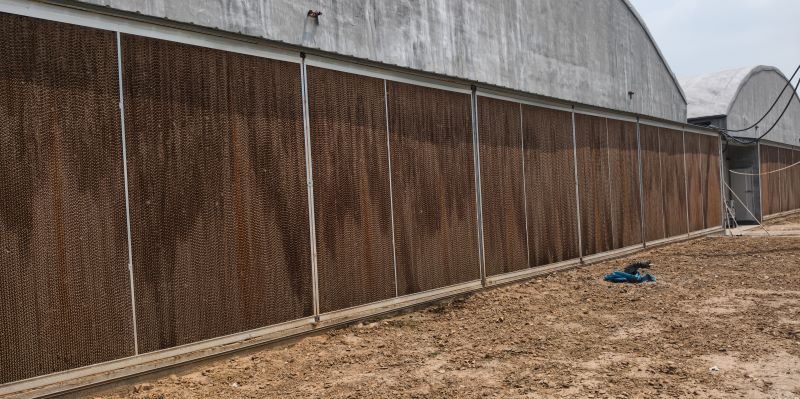
The process begins with the exhaust fans. By removing hot air from the house, they create negative pressure that draws outdoor air through the wetted cooling pads. As the air passes across the wet pad surface, part of the water evaporates. The energy required for evaporation is taken from the air, reducing its dry-bulb temperature before it enters the poultry house.
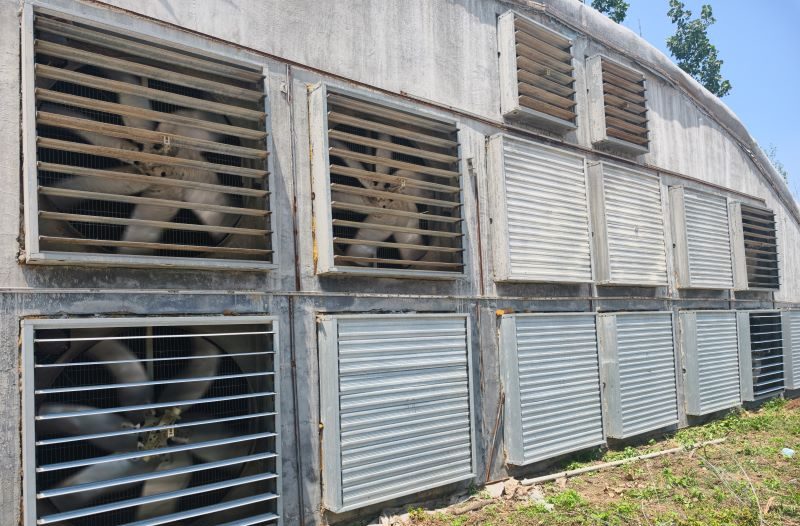
The actual temperature reduction is not a fixed value. Cooling performance depends strongly on outdoor relative humidity. Dry air generally has greater evaporation potential, while high humidity limits further evaporation. Air velocity, pad condition, water distribution, fan capacity, house sealing, and inlet design also affect the final result.
Under suitable hot and relatively dry conditions, a well-designed evaporative cooling system may produce a substantial temperature reduction. However, achieving a specific reduction such as 5–8°C should be treated as a site-specific result rather than a universal guarantee.
For poultry farms, effective cooling therefore depends on the entire system: properly sized fans, clean and evenly wetted pads, adequate airflow, good house sealing, and appropriate environmental control. Regular maintenance is essential for maintaining stable cooling performance throughout the summer.
Share this:
Other Posts
-
Poultry Farm Automation Trends: Why More Commercial Farms Are Adopting Automated Farming Systems
Poultry farm automation is becoming increasingly relevant as commercial farms seek greater efficiency, consistency, and better resource management. Automated feeding, drinking, ventilation, manure removal, and climate-control systems can reduce repetitive manual work and support more standardized daily operations. However, automation decisions should be based on farm scale, housing design, climate, production objectives, energy use, and…
-
Dynamic Feed Optimization Model Cuts Waste, Boosts Broiler Performance
A new trial shows that a dynamic feed optimization model based on age‑weight curves significantly improves broiler production. In a 35‑day test with 10,000 Ross 308 broilers, the model reduced feed waste from 8.2% to 2.2% (a 6% absolute cut), lowered feed conversion ratio (FCR) by 7.9%, and increased final body weight from 1.85 kg…
-
Quantifying Feed Loss in Poultry Farming: Spillage, Spoilage, and Feed Refusal Analysis
Feed loss is a key challenge in poultry production, directly affecting economic efficiency and resource utilization. This article provides a quantitative analysis of three primary sources of feed loss: spillage, spoilage, and feed refusal. By examining their causes, typical loss ratios, and influencing factors, the study highlights practical strategies for reducing waste. Optimizing feeder design,…
-
Development and Application of THI Early Warning Model: A Risk-Graded Alert Mechanism for Heat Stress Based on THI Thresholds
Heat stress in poultry is closely linked to temperature-humidity index (THI). A THI-based early warning model enables farms to act before birds suffer. The model defines four risk levels: THI < 74 (safe), 74–78 (caution), 79–83 (danger), and > 83 (emergency). Each threshold triggers specific actions—from increasing ventilation to activating cooling pads and adjusting feed…
Product Categories
Subscribe To Product News
Leave your email address and receive our latest product updates