Your cart is currently empty!
+86 15863276370

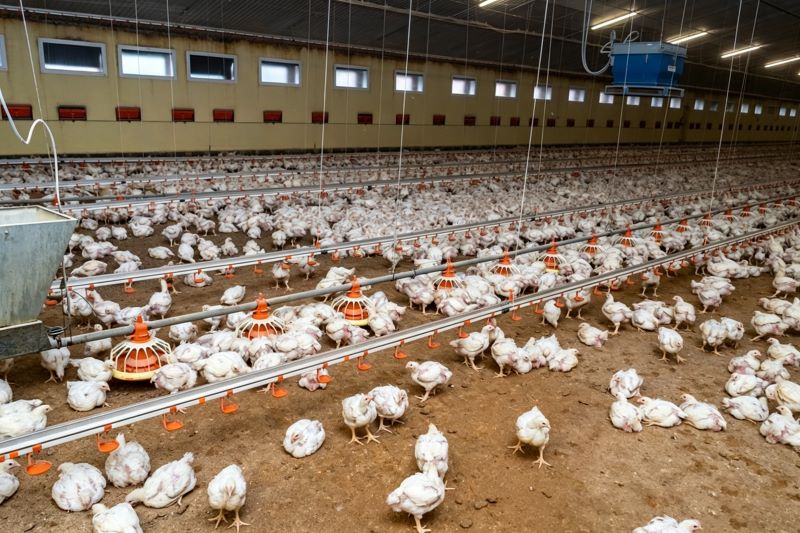
This study quantifies labor savings when replacing manual bag feeding with automated pneumatic conveying in a 10,000-bird broiler farm. Manual feeding involves lifting, carrying, tearing, and scattering 25–40 kg bags daily. Two full‑time workers spend 6–8 hours per day on these tasks, equivalent to 2,080–2,600 working hours annually per worker.
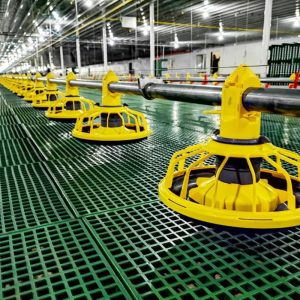
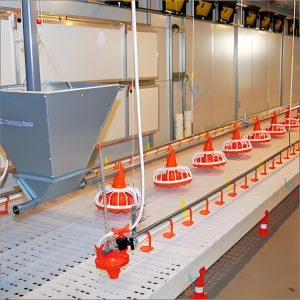
Automated feeding uses a silo, auger or chain conveyor, and pan feeders. Workers only fill the silo (via bulk truck) and monitor system operation. One part‑time worker spends less than 500 hours per year. The reduction in physical handling eliminates heavy lifting and repetitive motion, lowering injury risks and fatigue.
Time‑motion studies on three farms showed that automated systems cut feeding‑related labor by 83–91%. The empirical evidence confirms that replacing manual bag handling with pneumatic conveying reduces workforce demand from 2–3 full‑time to one part‑time worker, delivering both economic and ergonomic benefits.
Share this:
Other Posts
-
From Design to Implementation: A Practical Guide to Biosecurity Layout for Floor Rearing Farms
Effective biosecurity starts with a clear layout. Separate clean and dirty zones clearly. The entry point should include a changing room, footbath, and hand sanitizer. Place sealed fences around the farm to prevent wild birds and rodents from entering. Design a one-way flow: workers move from office to changing room to house, never backward. Vehicles…
-
Empirical Analysis of 5–10% Feed Savings in a 10,000-Broiler Farm
Feed cost accounts for the largest proportion of expenses in broiler farming, making efficiency improvements highly valuable. This study presents an empirical analysis of achieving 5–10% feed savings in a 10,000-broiler farm through optimized management and automated equipment. The research focuses on the application of precision feeding systems, uniform feed distribution, and reduced feed wastage.…
-
Semi-Automatic vs. Fully Automatic Poultry Farming Systems: ROI Comparison and Investment Guide
Choosing between a semi-automatic and fully automatic poultry farming system is an important investment decision. The right solution depends not only on equipment cost, but also on farm capacity, labor availability, management requirements, and long-term operating expenses.
-
Why Do Nipple Drinkers Leak? (With Troubleshooting Flowchart)
Leaking nipple drinkers waste water, wet litter, and increase disease risk. Understanding common failure causes helps farm managers quickly fix issues. Primary leak sources include: worn silicone seals (normal wear after 12–18 months), debris trapped in the valve (from poor water filtration), incorrect water pressure (above 0.2–0.3 bar), damaged nipple body (cracks from freezing or…
Product Categories
Subscribe To Product News
Leave your email address and receive our latest product updates