Your cart is currently empty!
+86 15863276370

This study quantifies how dynamic feed adjustment improves feed conversion ratio (FCR) in broiler production. Dynamic adjustment tailors daily feed amounts to match real-time bird weight and intake patterns, unlike fixed feeding schedules.
A 35-day trial on 10,000 Ross 308 broilers compared dynamic adjustment (sensor‑based, every 2–4 hours) with conventional fixed feeding. Results showed that dynamic adjustment reduced FCR from 1.64 to 1.51, an improvement of 0.13 (7.9%). Feed waste dropped from 8.2% to 2.2%, and final body weight increased from 1.85 kg to 2.05 kg.
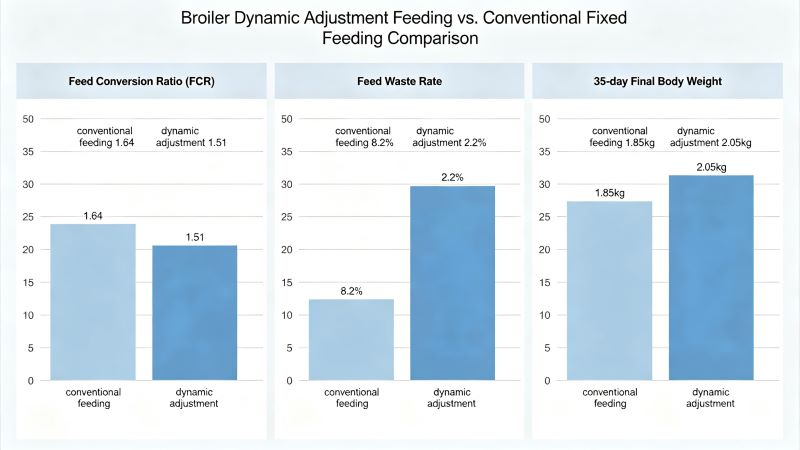
Regression analysis revealed that each 1% reduction in feed waste correlated with a 0.018 improvement in FCR. The precision of dynamic feeding reduced overfeeding during late stages and underfeeding during early growth. Consequently, FCR optimization directly lowers feed costs, which account for 60–70% of total production expenses. Dynamic adjustment offers a measurable, cost‑effective tool for broiler farms.
Share this:
Other Posts
-
Annual Feed Savings Estimation for a 10,000-Bird Broiler Farm Using Precision Feeding
Precision feeding delivers exact feed amounts based on real-time bird weight and intake patterns, minimizing waste. For a 10,000-bird flock with a 40-day cycle and average feed conversion ratio (FCR) of 1.6, total feed consumption reaches roughly 16,000 kg per cycle. Manual feeding typically wastes 5–10% of feed due to spillage, spoilage, and uneven distribution.…
-
El Niño Impact on Broiler House Climate Control: Adaptive Ventilation and Cooling Strategies for Temperature and Humidity Management
El Niño events may create additional challenges for poultry production by influencing temperature patterns, humidity levels, and precipitation conditions in some regions. This article analyzes the potential impacts of climate fluctuations on broiler house environmental management and discusses adaptive strategies including ventilation system upgrades, evaporative cooling coordination, and real-time environmental monitoring. Effective climate control requires…
-
Variable-Frequency Fans and Multi-Stage Cooling Linkage Control: Response Mechanism of Smart Environmental Control Systems to Extreme Heat
Extreme heat events threaten poultry health and productivity. Smart environmental control systems employ variable-frequency fans (VFFs) and multi-stage cooling linkage to respond effectively. VFFs automatically adjust speed based on real-time temperature, providing low airflow during mild heat and maximum speed during heatwaves. This saves energy while maintaining bird comfort. Multi-stage cooling activates sequentially: first, tunnel…
-
Poultry Fan Noise Suddenly Increases? 3-Step Troubleshooting Guide
A sudden increase in poultry fan noise can indicate problems with blades, bearings, motors, or mounting components. This article provides a three-step inspection method covering fan blades, moving components, and installation structures. Regular cleaning and maintenance can help identify abnormal vibration and mechanical problems early. Safe power isolation is essential before inspection, while electrical and…
Product Categories
Subscribe To Product News
Leave your email address and receive our latest product updates