Your cart is currently empty!
+86 15863276370

Extreme heat events threaten poultry health and productivity. Smart environmental control systems employ variable-frequency fans (VFFs) and multi-stage cooling linkage to respond effectively. VFFs automatically adjust speed based on real-time temperature, providing low airflow during mild heat and maximum speed during heatwaves. This saves energy while maintaining bird comfort.
Multi-stage cooling activates sequentially: first, tunnel ventilation; second, evaporative cooling pads; third, high-pressure fogging when temperature exceeds 30°C. Sensors feed data to a central controller, which triggers each stage at preset thresholds.
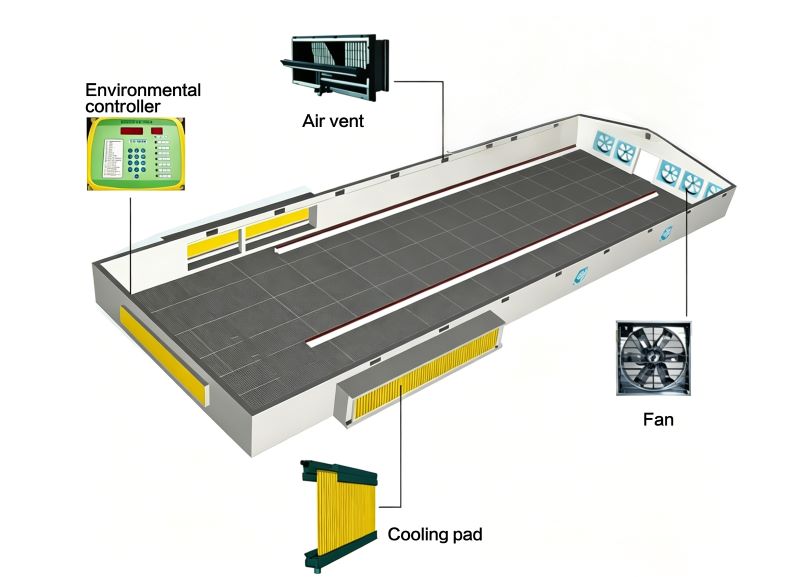
In field tests, this linkage reduced house temperature fluctuations by 40% and energy consumption by 25% compared to on/off systems. Mortality during extreme heat dropped by 30%. The response mechanism ensures rapid, proportionate cooling, protecting flocks without wasteful overcooling.
Share this:
Other Posts
-
Poultry House Cooling Sequence During Extreme Heat: When to Start Tunnel Fans and Evaporative Cooling Pads
Extreme heat requires a coordinated cooling strategy in poultry houses. A staged approach generally begins with increased tunnel ventilation to remove accumulated heat and improve air movement. Evaporative cooling pads can then be introduced when ventilation alone is insufficient, provided that humidity and airflow conditions are suitable. During severe heat, fans and cooling pads can…
-
ROI Analysis of Precision Feeding Systems in Poultry Farming: How Smart Feeding Improves Feed Efficiency and Operational Performance
Precision feeding systems are becoming increasingly important in modern poultry production as farms seek better feed efficiency and more standardized management. This article analyzes the investment value of precision feeding technology by examining its impact on feeding accuracy, feed utilization, labor requirements, and operational efficiency. The ROI of such systems depends on factors including farm…
-
Intelligent Broiler Farming Equipment: Setting a New Benchmark for Efficient Farming
With the scaling development of the poultry industry, modern broiler farming equipment has become key to improving profitability. We specialize in the R&D and production of a series of farming equipment, helping farmers achieve efficient, labor-saving, and scientific feeding management. Core equipment includes: Our equipment is characterized by durability, ease of operation, and energy efficiency.…
-
Nighttime Feeding and Light Regulation Strategies: Behavioral Intervention to Avoid High-Temperature Periods and Impacts on Growth Performance
High ambient temperatures suppress feed intake in broilers, reducing growth and feed efficiency. Nighttime feeding combined with adjusted light schedules offers an effective solution. By shifting feeding to cooler evening and early morning hours, birds consume more feed when heat stress is minimal. A light regimen of 4 hours light, 2 hours dark during nighttime…
Product Categories
Subscribe To Product News
Leave your email address and receive our latest product updates