Your cart is currently empty!
+86 15863276370

Effective ventilation is critical for poultry house air quality. This scheme integrates floor-level inlets with ridge outlets, blending natural and mechanical forces. Floor-level inlets, placed along side walls near the litter, allow fresh air to enter at bird level. Ridge outlets, installed at the roof peak, enable warm, stale air to rise naturally.
During mild weather, thermal buoyancy drives airflow from inlets to ridge outlets, often meeting ventilation needs without mechanical assistance—a well-documented principle (e.g., ASHRAE Handbook). However, fans remain valuable as a backup or when heat/humidity rise. In such cases, mechanical fans at ridge outlets activate to boost extraction, ensuring air quality under all conditions.
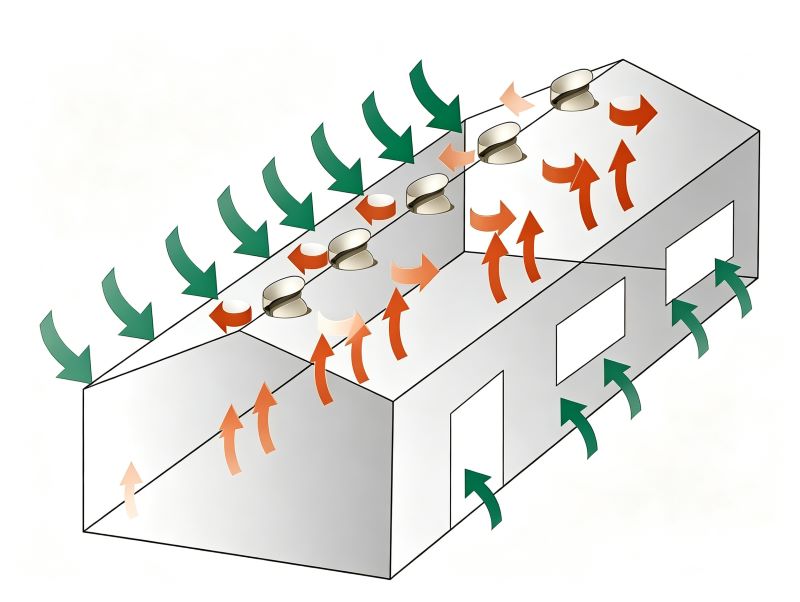
Computational fluid dynamics (CFD) simulations show this hybrid design reduces dead zones by 40% and improves air velocity uniformity. Compared to fan-only systems, energy consumption drops 30% while fans operate only when needed. Field trials confirm lower respiratory disease rates and better litter condition. The system is low-cost, suitable for retrofitting conventional houses, and respects the complementary role of fans.
Share this:
Other Posts
-
Cage vs. Floor Rearing for 1,000 Birds: A Side‑by‑Side Comparison
For a 1,000‑bird flock, the choice between cage and floor systems affects costs, labor, and risk. For small farms with 1,000 birds, floor rearing is often more practical due to lower entry cost and simpler biosecurity. However, if space is extremely limited and local regulations allow, cages may boost output. Choose based on your target…
-
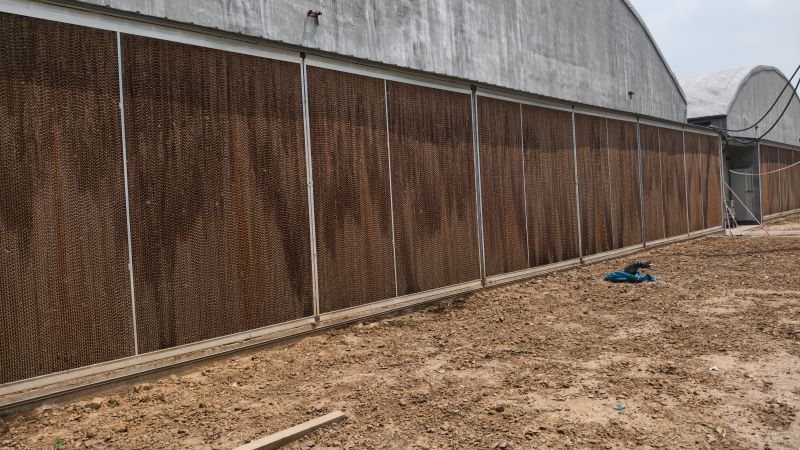
How Do Poultry House Cooling Pads and Exhaust Fans Work? Understanding Evaporative Cooling in Summer
Keeping poultry houses within a suitable temperature range during summer is an important part of environmental management. A combination of evaporative cooling pads and exhaust fans is widely used because the two systems work together to move and cool incoming air. The process begins with the exhaust fans. By removing hot air from the house,…
-
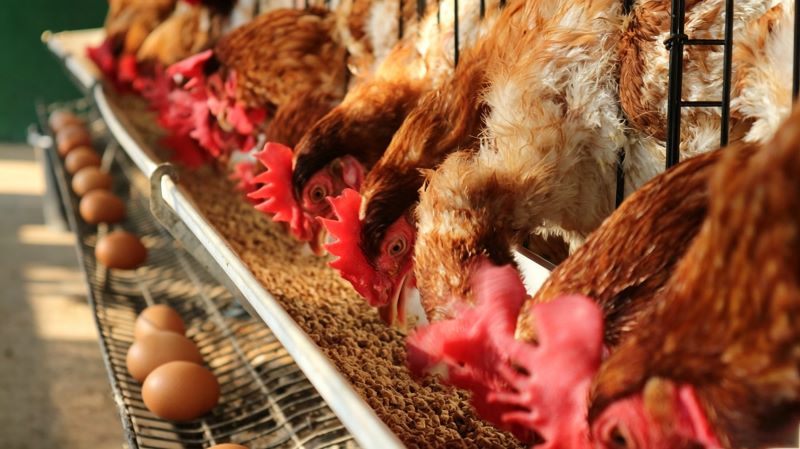
Manual Feeding vs Precision Feeding Systems in Poultry Farming: Efficiency, Cost, and Feed Conversion Comparison
Feed management is one of the most critical factors affecting productivity and cost efficiency in poultry farming. Traditionally, manual feeding has been widely used due to its simplicity and low initial investment. However, with the development of automation technology, precision feeding systems are increasingly replacing manual operations in modern poultry houses. Manual feeding relies heavily…
-
Quantitative Assessment of Dynamic Feed Adjustment in Reducing Overfeeding and Underfeeding
Dynamic feed adjustment tailors daily feed amounts to match broilers’ actual growth curves and real-time intake patterns. This study quantifies its effect on reducing overfeeding and underfeeding in a 10,000‑bird flock. Overfeeding occurs when feed supply exceeds birds’ needs, increasing feed conversion ratio (FCR) and fat deposition. Underfeeding limits growth and causes flock unevenness. Using…
Product Categories
Subscribe To Product News
Leave your email address and receive our latest product updates