Your cart is currently empty!
+86 15863276370

A new trial shows that a dynamic feed optimization model based on age‑weight curves significantly improves broiler production.
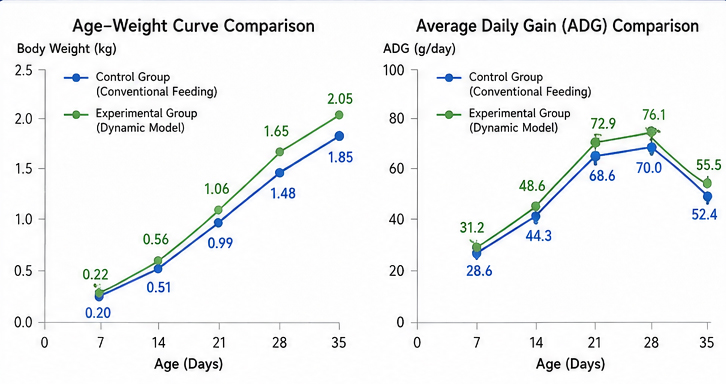
In a 35‑day test with 10,000 Ross 308 broilers, the model reduced feed waste from 8.2% to 2.2% (a 6% absolute cut), lowered feed conversion ratio (FCR) by 7.9%, and increased final body weight from 1.85 kg to 2.05 kg (+11.1%). Flock uniformity improved 12%, and mortality dropped by 3.8 percentage points.
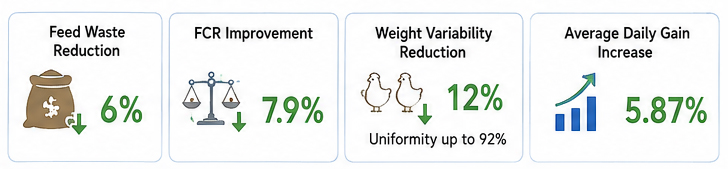
Unlike fixed feeding, the model adjusts feed portions every 2–4 hours using weekly weight samples, real‑time algorithms, and high‑precision sensors (±1g). The system is ready for integration with automated feeders in commercial floor rearing farms.
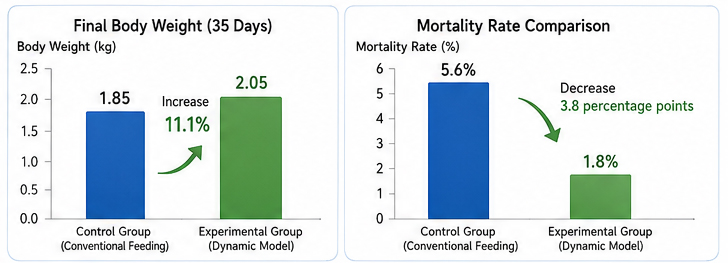
This data‑driven approach reduces feed costs (60–70% of total production cost) and enhances flock health. It represents a practical step toward precision poultry farming.
Share this:
Other Posts
-
Cage vs. Floor Housing for Poultry Farms: 20 Key Factors to Consider Before Choosing a System
Choosing between cage and floor housing requires a comprehensive evaluation of farm conditions rather than relying on a single factor. This article compares 20 practical dimensions, including space utilization, investment, labor, feeding, manure management, ventilation, automation, and long-term operating costs. Cage systems may provide higher vertical space utilization, while floor housing can suit different production…
-
Hello world!
Welcome to WordPress. This is your first post. Edit or delete it, then start writing!
-
Global Broiler Equipment Market to Reach $6.87 Billion by 2035
The global broiler farming equipment market is expanding steadily. Valued at $4.18 billion in 2025, it is projected to grow to $6.87 billion by 2035, driven by rising poultry consumption and farm automation. Key growth factors include labor shortages in developed regions, stricter animal welfare regulations favoring floor rearing systems, and climate‑resilient technologies such as…
-
Indonesia, Vietnam, the Philippines: Opportunities and Entry Strategies for Floor Rearing Equipment in Southeast Asia’s Three Key Markets
Southeast Asia’s poultry sector is shifting from backyard farming to commercial production, creating strong demand for floor rearing equipment. Indonesia, Vietnam, and the Philippines represent the region’s most promising markets. Indonesia has the largest broiler population but faces fragmentation. Success requires affordable semi‑automated systems and local after‑sales support. Vietnam’s market is more structured, with growing…
Product Categories
Subscribe To Product News
Leave your email address and receive our latest product updates