Your cart is currently empty!
+86 15863276370

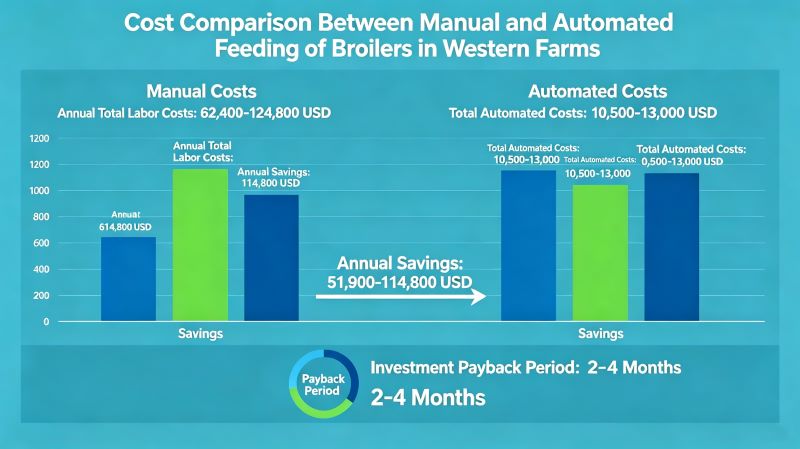
In the US and EU, hourly wages for farm labor range from 15to20. Manual feeding of a 10,000-bird house requires two to three full‑time workers. Annual labor cost per worker (2,080 hours) is 31,200–41,600. Thus, total manual feeding labor costs 62,400–124,800 per year.
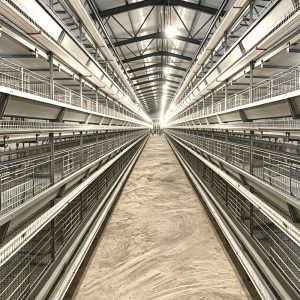
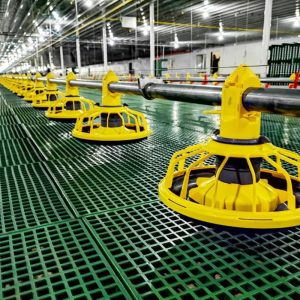
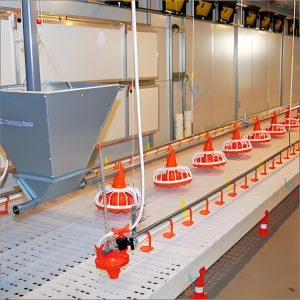
Automated feeding systems (silo, auger, pan feeders) reduce this to one part‑time worker (approx. 500 hours/year) costing 7,500–10,000, plus maintenance and electricity (3,000).Totalautomatedcost:10,500–$13,000.
Annual saving = 51,900–114,800, effectively replacing 2–3 workers. For a $15,000 automated system, payback period is 2–4 months. Automation delivers clear labor cost reduction in high‑wage markets.
Share this:
Other Posts
-
Predictive Climate Control in Poultry Farming: Using Weather Forecast Data to Reduce Heat Stress Risks
Heat stress management is one of the most important challenges in modern poultry production, especially in regions experiencing frequent extreme temperature events. Traditional environmental control systems mainly respond after temperature changes occur, while predictive climate control combines weather forecast data with automated equipment management to improve farm preparedness. A predictive control model uses external weather…
-
All-In, All-Out, Complete Sanitization: Why Floor Rearing Systems Achieve Disease Elimination
Floor rearing systems offer a distinct advantage in disease control through the all-in, all-out management model. Unlike cage systems where birds remain in place across cycles, floor houses allow complete depopulation between flocks. This empty period enables thorough cleaning of every surface—walls, floors, feeders, and drinkers. Without cages obstructing access, disinfectants reach all areas, eliminating…
-
Modern Poultry Farming Equipment: 2026 Global Trends & Market Growth
Explore how modern poultry farming equipment transforms broiler farms. Automated feeding, AI monitoring, EU cage ban, and market forecast to 2030. Read more.
-
Manual Feeding vs Precision Feeding Systems in Poultry Farming: Efficiency, Cost, and Feed Conversion Comparison
Feed management is one of the most critical factors affecting productivity and cost efficiency in poultry farming. Traditionally, manual feeding has been widely used due to its simplicity and low initial investment. However, with the development of automation technology, precision feeding systems are increasingly replacing manual operations in modern poultry houses. Manual feeding relies heavily…
Product Categories
Subscribe To Product News
Leave your email address and receive our latest product updates