Your cart is currently empty!
+86 15863276370

Leaking nipple drinkers waste water, wet litter, and increase disease risk. Understanding common failure causes helps farm managers quickly fix issues.
Primary leak sources include: worn silicone seals (normal wear after 12–18 months), debris trapped in the valve (from poor water filtration), incorrect water pressure (above 0.2–0.3 bar), damaged nipple body (cracks from freezing or impact), and loose connections at the pipe joint.
A systematic troubleshooting flowchart follows: check water pressure first (adjust regulator to 0.2 bar). Then inspect for external cracks. Next, disassemble the nipple, clean any debris, and examine the seal. Replace worn seals or damaged units. Finally, verify proper installation angle (vertical ±5°).
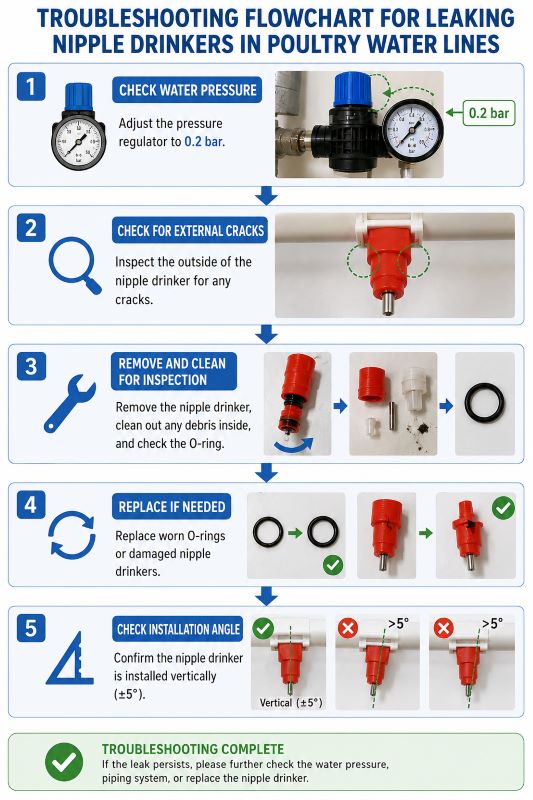
Preventive measures: install inline filters, flush lines weekly, maintain stable pressure, and replace seals annually. Regular checks reduce leakage by over 80%. A visual flowchart (pressure → visual inspection → cleaning → seal replacement) guides operators step by step, saving time and litter quality.
Share this:
Other Posts
-
What’s the Payback Gap? An Empirical ROI Comparison of Semi‑Automated vs. Fully Automated Floor Rearing Equipment
This study compares payback periods for semi‑automated (auto feeders only) and fully automated (feeders + ventilation + manure removal) floor rearing systems in a 10,000‑bird house. Semi‑automated equipment costs $8,000–$10,000, saving 70% of feeding labor and 5% of feed waste. Fully automated systems cost $25,000–$30,000 but eliminate 90% of labor and reduce feed waste by…
-
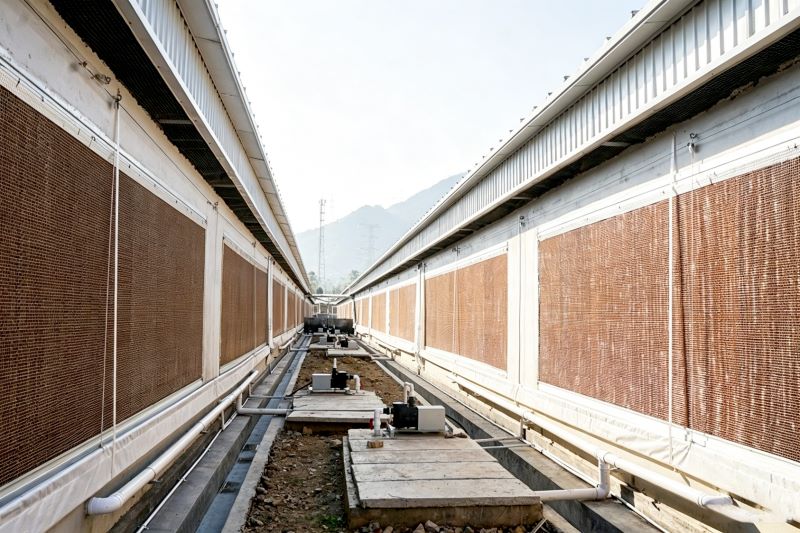
Synergistic Optimization of Cooling Pad Expansion and Water Quality Management: Strategies for Improving Evaporative Cooling Efficiency in Hot and Humid Regions
In tunnel-ventilated poultry houses, evaporative cooling pad performance directly impacts bird welfare and productivity during summer. Two critical factors determine system effectiveness: proper pad sizing and water quality management. Pad Sizing Principles Pad area should be determined by total tunnel fan capacity, not house dimensions. Industry standard recommends one square foot of six-inch pad for…
-
Intelligent Broiler Farming Equipment: Setting a New Benchmark for Efficient Farming
With the scaling development of the poultry industry, modern broiler farming equipment has become key to improving profitability. We specialize in the R&D and production of a series of farming equipment, helping farmers achieve efficient, labor-saving, and scientific feeding management. Core equipment includes: Our equipment is characterized by durability, ease of operation, and energy efficiency.…
-
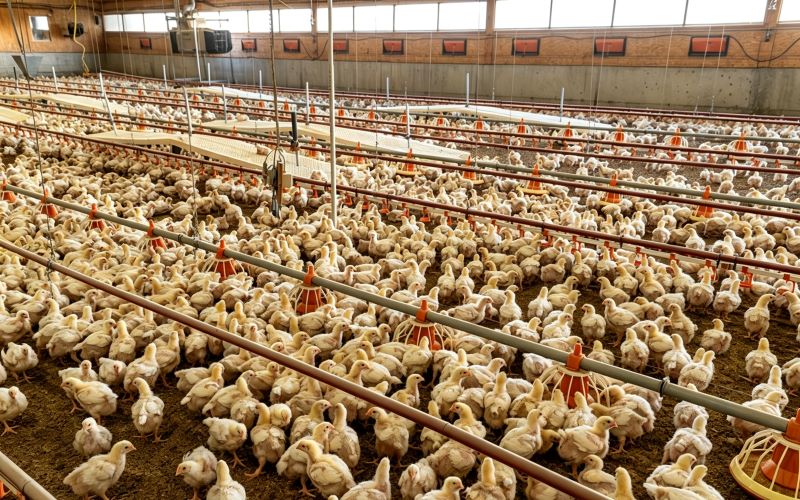
Seasonal Stocking Density Management in Poultry Farming: Dynamic Matching of Bird Density and Heat Load Under Different Temperature Conditions
Stocking density is a critical management factor affecting animal welfare, environmental control efficiency, and production performance in commercial poultry farming. During seasonal temperature changes, maintaining the appropriate bird density becomes increasingly important because heat production from flocks directly influences the internal climate of poultry houses. A seasonal stocking density adjustment model evaluates the relationship between…
Product Categories
Subscribe To Product News
Leave your email address and receive our latest product updates