Your cart is currently empty!
+86 15863276370

Heat stress management is one of the most important challenges in modern poultry production, especially in regions experiencing frequent extreme temperature events. Traditional environmental control systems mainly respond after temperature changes occur, while predictive climate control combines weather forecast data with automated equipment management to improve farm preparedness.
A predictive control model uses external weather information, historical climate data, and real-time house environmental monitoring to estimate upcoming temperature risks. Before extreme heat conditions occur, the system can adjust ventilation strategies, cooling equipment operation, and airflow management in advance, creating a more stable internal environment for birds.
For example, when weather forecasts indicate a significant temperature increase, poultry house management systems can prepare by increasing ventilation capacity, optimizing fan operation schedules, and activating cooling equipment at appropriate times. This proactive approach reduces sudden environmental fluctuations and helps minimize heat stress pressure on broiler flocks.
Compared with traditional reactive management, predictive environmental control improves decision-making efficiency by transforming climate management from a response-based process into a prevention-oriented strategy. Field applications show that integrated forecasting and environmental control systems can improve temperature stability and reduce unnecessary energy consumption when properly configured.
The effectiveness of predictive control depends on multiple factors, including local climate conditions, house insulation performance, ventilation design, equipment reliability, and management practices. Therefore, weather forecasting should be integrated with a complete poultry house environmental management system rather than used as an independent solution.
As climate variability increases worldwide, predictive climate control technologies are becoming an important direction for intelligent poultry farming. By combining data analysis with automated ventilation and cooling systems, farms can achieve more stable production conditions and improve operational resilience.
Share this:
Other Posts
-
Nighttime Feeding and Light Regulation Strategies: Behavioral Intervention to Avoid High-Temperature Periods and Impacts on Growth Performance
High ambient temperatures suppress feed intake in broilers, reducing growth and feed efficiency. Nighttime feeding combined with adjusted light schedules offers an effective solution. By shifting feeding to cooler evening and early morning hours, birds consume more feed when heat stress is minimal. A light regimen of 4 hours light, 2 hours dark during nighttime…
-
How to Choose Your Poultry System
How to Choose the Right Poultry Farming System and Equipment Selecting the right farming method and equipment starts with evaluating your farm scale, climate conditions, and target market. Floor rearing is suitable for welfare-focused farms, offering lower initial investment, easier all-in/all-out sanitation management, and relatively simple litter handling. Cage systems maximize stocking density but face…
-
The Future of Large-Scale Smart Poultry Farming
The outlook for large-scale smart poultry farming is exceptionally promising globally, driven by the need to feed a growing population sustainably. These technologically advanced farms represent a significant evolution from traditional methods, integrating automation, data analytics, and the Internet of Things (IoT). Key development advantages are substantial. Firstly, precision farming using sensors and AI monitors…
-
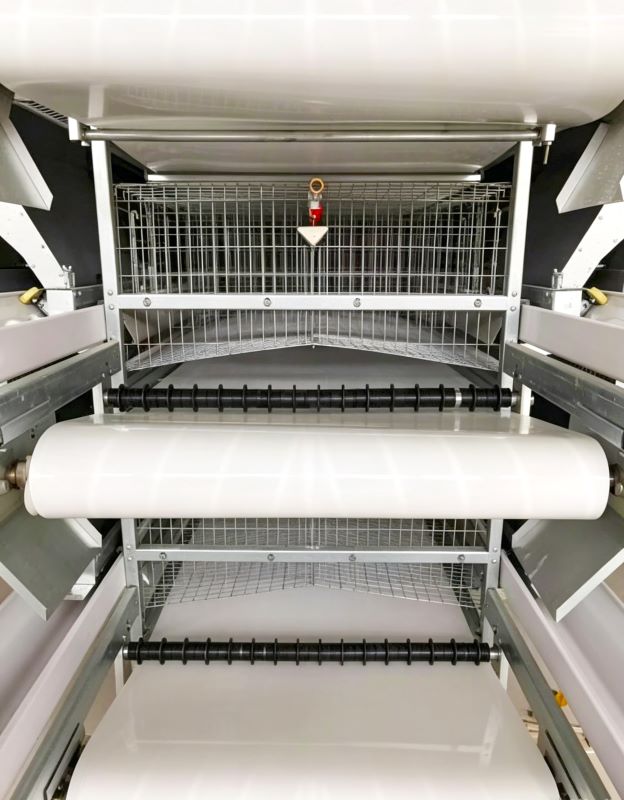
Manure Conveyor Belt Tracking Adjustment – Fix It Yourself Without a Service Call
Belt misalignment (tracking off) is a common issue in floor rearing houses. Most cases are caused by uneven tension, non‑parallel rollers, or uneven load distribution. Follow these three steps to fix it yourself. Step 1: Identify the direction and locationRun the belt empty and observe which side it shifts toward. If the belt runs to…
Product Categories
Subscribe To Product News
Leave your email address and receive our latest product updates