Your cart is currently empty!
+86 15863276370

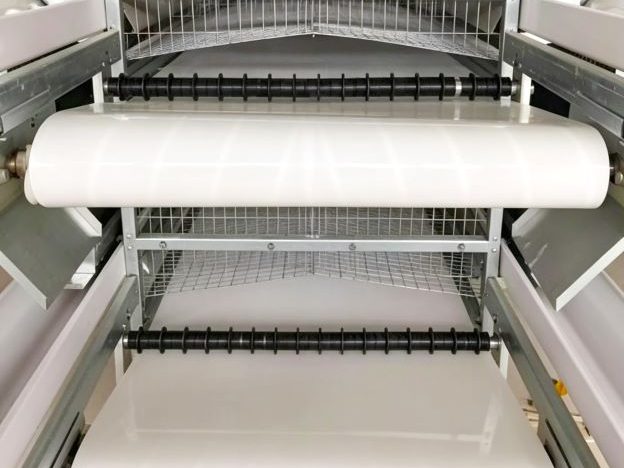
Belt misalignment (tracking off) is a common issue in floor rearing houses. Most cases are caused by uneven tension, non‑parallel rollers, or uneven load distribution. Follow these three steps to fix it yourself.

Step 1: Identify the direction and location
Run the belt empty and observe which side it shifts toward. If the belt runs to the right, the right side is too tight or the left side too loose. Mark the offset at the head and tail pulleys to distinguish between full‑belt drift vs. local twisting.
Step 2: Adjust the tail tension screws
This is the most effective method. If the belt tracks to the right, tighten the right‑side tension screw clockwise (increase tension on that side) and simultaneously loosen the left‑side screw counterclockwise. Adjust by ¼ turn each time, run the belt for 2–3 revolutions, and repeat until centered.
⚠️ Note: The total adjustment amount on both sides must be equal – tightening one side by ¼ turn means loosening the opposite side by exactly ¼ turn. Otherwise, the pulley will become skewed.
Step 3: Check head and tail pulley parallelism
If tension adjustment fails, measure the distance between both ends of the head and tail pulleys with a tape measure. If the deviation exceeds 5 mm (0.2 inches), loosen the mounting bolts and use shims or jacking screws to correct parallelism. Once parallel, tracking usually returns to normal.
Special Cases
- Local twisting: Check the belt joint for skew or damage; re‑weld or re‑splice if needed.
- Uneven load: Uneven manure distribution on the belt – adjust the scraper blade level.
Preventive Tips
Run the belt empty weekly for a quick check. Quarterly, measure bearing temperature with an infrared thermometer (should not exceed ambient +40°C / 104°F). Avoid overloading the belt beyond 120% of design capacity.
With this method, 90% of misalignment issues can be solved within 15 minutes without calling a technician.
Share this:
Other Posts
-
Global Broiler Equipment Market to Reach $6.87 Billion by 2035
The global broiler farming equipment market is expanding steadily. Valued at $4.18 billion in 2025, it is projected to grow to $6.87 billion by 2035, driven by rising poultry consumption and farm automation. Key growth factors include labor shortages in developed regions, stricter animal welfare regulations favoring floor rearing systems, and climate‑resilient technologies such as…
-
From Design to Implementation: A Practical Guide to Biosecurity Layout for Floor Rearing Farms
Effective biosecurity starts with a clear layout. Separate clean and dirty zones clearly. The entry point should include a changing room, footbath, and hand sanitizer. Place sealed fences around the farm to prevent wild birds and rodents from entering. Design a one-way flow: workers move from office to changing room to house, never backward. Vehicles…
-
EU’s 2027 Cage Ban: How Long Will the Policy-Driven Boom for Floor Rearing Equipment Last?
The EU will ban conventional cages for laying hens and broilers by 2027. This regulation forces farms to switch to cage‑free systems, primarily floor rearing and aviaries. Consequently, demand for floor rearing equipment—feeders, drinkers, litter management, and ventilation—has surged. Market analysts estimate that the transition affects over 300 million hens in Europe alone. Replacement cycle…
-
A New Era of Human‑Machine Collaboration: Challenges and Solutions for Deploying AI Decision Systems in Floor‑Rearing Farms
Deploying AI decision systems in floor‑rearing farms promises improved efficiency but faces practical hurdles. Three major challenges emerge: data infrastructure gaps, worker acceptance, and system maintenance cost. Many farms lack reliable sensors or stable internet, leading to incomplete data. Workers, accustomed to manual observation, often distrust AI recommendations. Solutions include phased deployment starting with basic…
Product Categories
Subscribe To Product News
Leave your email address and receive our latest product updates