Your cart is currently empty!
+86 15863276370

Evaporative cooling pads can help reduce incoming air temperature in poultry houses, but their performance depends on more than the cooling pad itself. Before installation, farms should evaluate three key conditions: house sealing, fan capacity, and water supply.
1. Is the poultry house sufficiently sealed?
Evaporative cooling works best when incoming air follows the intended path through the cooling pads. Uncontrolled openings, damaged curtains, or air leakage may allow outside air to bypass the pads, reducing cooling efficiency and affecting airflow distribution. The house should therefore be inspected for unnecessary air leaks before system installation.
2. Is the fan configuration suitable?
Cooling pads must work together with properly designed exhaust fans. The fan system should create sufficient negative pressure to draw outside air evenly through the pad area and across the poultry house. Fan capacity, house dimensions, inlet area, and ventilation design should be evaluated as one system rather than as separate components.
3. Is the water supply adequate and stable?
The water system should provide sufficient flow for uniform pad wetting during operation. Water quality is also important because high mineral content or sediment can contribute to scaling and uneven water distribution over time. Farms should assess water flow, storage capacity, filtration, and basic water quality before installation.
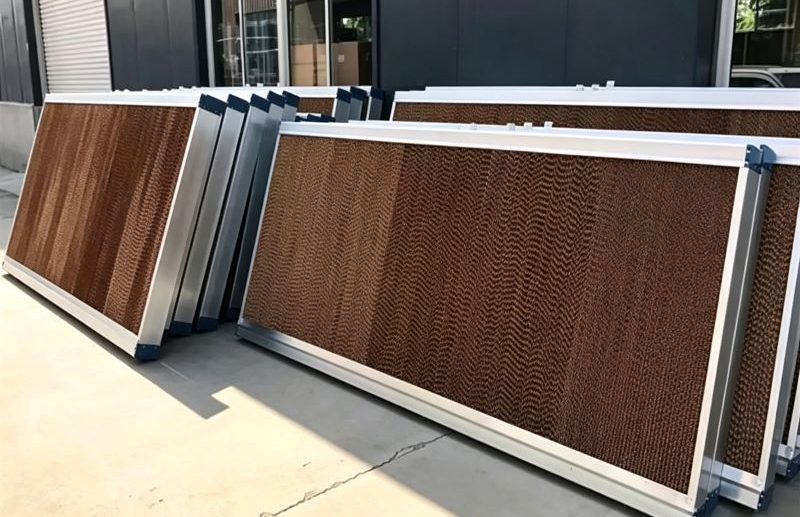
A successful evaporative cooling system is not determined by pad size alone. Proper house sealing, matched ventilation capacity, and reliable water conditions are all essential parts of system design. Evaluating these factors before installation can help farms select a configuration better suited to their climate and poultry house requirements.
Share this:
Other Posts
-
Why Automated Floor Rearing Systems Are Transforming Broiler Farming
Automated floor rearing systems help broiler farms cut labor costs by up to 70%, reduce feed waste by 5–10%, improve bird health through natural movement, and enable all‑in/all‑out sanitation for better disease control. With a strong ROI of 12–24 months, they also help farms meet animal welfare standards. As the industry moves toward cage‑free and…
-
Cage vs. Floor Rearing for 1,000 Birds: A Side‑by‑Side Comparison
For a 1,000‑bird flock, the choice between cage and floor systems affects costs, labor, and risk. For small farms with 1,000 birds, floor rearing is often more practical due to lower entry cost and simpler biosecurity. However, if space is extremely limited and local regulations allow, cages may boost output. Choose based on your target…
-
Professional Broiler Breeding Equipment, Boosting Efficient Farming
As a professional manufacturer of broiler breeding equipment, we are committed to providing advanced layer-stacked broiler cage systems for farmers. Our products are made of high-quality hot-dip galvanized steel with a service life of over 15 years, featuring corrosion resistance and anti-aging properties to ensure long-term stable operation. Core Advantages: Our equipment adopts a frame…
-
Synergistic Design of Floor-Level Inlets and Ridge Outlets: An Airflow Optimization Scheme Combining Natural and Mechanical Ventilation
Effective ventilation is critical for poultry house air quality. This scheme integrates floor-level inlets with ridge outlets, blending natural and mechanical forces. Floor-level inlets, placed along side walls near the litter, allow fresh air to enter at bird level. Ridge outlets, installed at the roof peak, enable warm, stale air to rise naturally. During mild…
Product Categories
Subscribe To Product News
Leave your email address and receive our latest product updates