Your cart is currently empty!
+86 15863276370

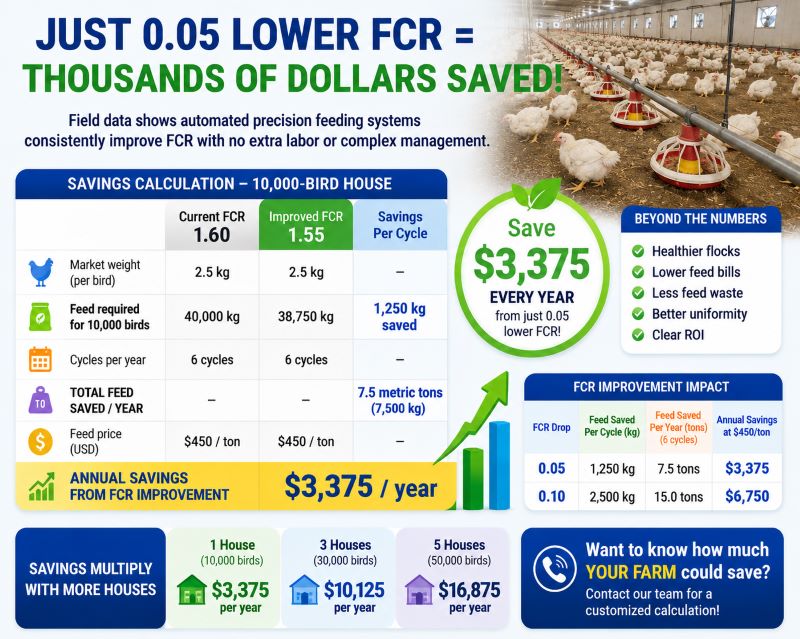
What if reducing your feed conversion ratio (FCR) by just 0.05 could save thousands of dollars every year? Our latest field data confirms that automated precision feeding systems consistently achieve this gain – with no extra labor or complex management.
Here’s the math for a standard 10,000‑bird house:
- Average market weight: 2.5 kg per bird
- FCR drops from 1.60 to 1.55
- Feed saved per cycle: 1,250 kg
- With 6 cycles per year → 7.5 metric tons of feed saved
At today’s feed price of $450/ton, that’s **$3,375 saved annually** – from FCR improvement alone. If your farm has multiple houses, the savings multiply. And when FCR improves by 0.10, the benefit doubles.
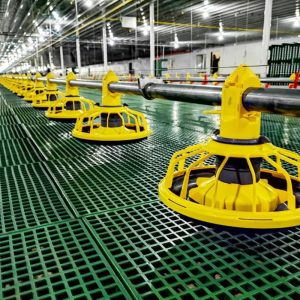
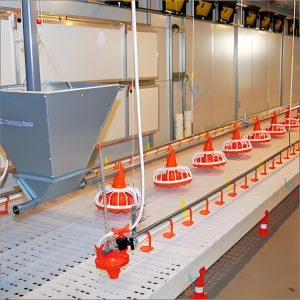
But the real story is not just math. Automated feeders adjust portions based on real bird weight and intake patterns. They eliminate overfeeding and reduce waste. The result: healthier flocks, lower feed bills, and a clear return on investment.
Want to know how much your farm could save? Contact our team for a customized calculation.
Share this:
Other Posts
-
Semi-Automatic vs. Fully Automatic: Investment Payback and Decision Reference
Based on 2025-2026 international industry data, the choice between semi-automatic and fully automatic upgrades hinges on production scale and capital strategy.Semi-automatic lines offer a lower entry barrier, with initial investments typically 35-60% lower than fully automatic counterparts. For instance, in sectors like block making, semi-automatic machines cost $25,000-$50,000 versus $80,000-$150,000 for full automation. While requiring…
-
Quantified Effect of Dynamic Feed Adjustment on Feed Conversion Ratio Optimization
This study quantifies how dynamic feed adjustment improves feed conversion ratio (FCR) in broiler production. Dynamic adjustment tailors daily feed amounts to match real-time bird weight and intake patterns, unlike fixed feeding schedules. A 35-day trial on 10,000 Ross 308 broilers compared dynamic adjustment (sensor‑based, every 2–4 hours) with conventional fixed feeding. Results showed that…
-
Optimizing Litter Depth and Turning Frequency: A Litter Management Strategy to Reduce Microbial Fermentation Heat
Litter moisture and microbial activity generate heat inside poultry houses, increasing bird heat stress and ammonia emissions. This study examines how adjusting litter depth and turning frequency can mitigate fermentation heat. Deep litter (over 15 cm) insulates and promotes anaerobic zones, raising core temperature. Shallow litter (below 5 cm) dries quickly but fails to absorb…
-
Labor Cost Estimation in the US and EU: How Automated Feeding Replaces 2–3 Workers per 10,000-Bird Broiler Farm
In the US and EU, hourly wages for farm labor range from 15to15to20. Manual feeding of a 10,000-bird house requires two to three full‑time workers. Annual labor cost per worker (2,080 hours) is 31,200–31,200–41,600. Thus, total manual feeding labor costs 62,400–62,400–124,800 per year. Automated feeding systems (silo, auger, pan feeders) reduce this to one part‑time worker (approx. 500…
Product Categories
Subscribe To Product News
Leave your email address and receive our latest product updates