Your cart is currently empty!
+86 15863276370

This study builds an ROI model to evaluate automation upgrades for a 10,000-bird floor rearing farm. The model compares total investment (equipment + installation) against annual savings from labor, feed, medication, and mortality reduction.
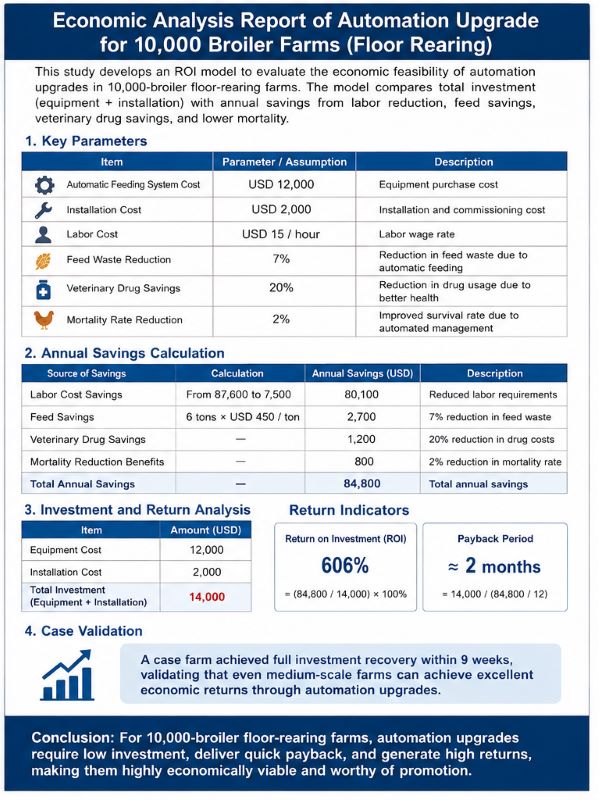
Key inputs: automated feeding system cost – 12,000;manuallaborcost–15/hour; feed waste reduction – 7%; mortality decrease – 2%; medication saving – 20%.
Calculation: Annual savings = labor (87,600→7,500) + feed (6 tons × 450=2,700) + medication (1,200)+mortalityreduction(800) = 84,800total.Investment=14,000 (including installation).
ROI = (84,800/14,000) × 100% = 606%. Payback period = 14,000/(84,800/12) ≈ 2 months. A case farm achieved full payback in 9 weeks, validating strong economic justification for automation upgrade even at moderate scale.
Share this:
Other Posts
-
Equipment + Service” Model: The Next Growth Driver in Biosecurity Equipment Market
As disease outbreaks become more frequent, poultry farms are shifting from buying standalone biosecurity equipment to seeking integrated solutions. The “equipment + service” model is emerging as a key growth driver in this space. This model combines hardware—such as automated disinfection channels, air filtration systems, and smart access controls—with value-added services like biosecurity audits, sanitation…
-
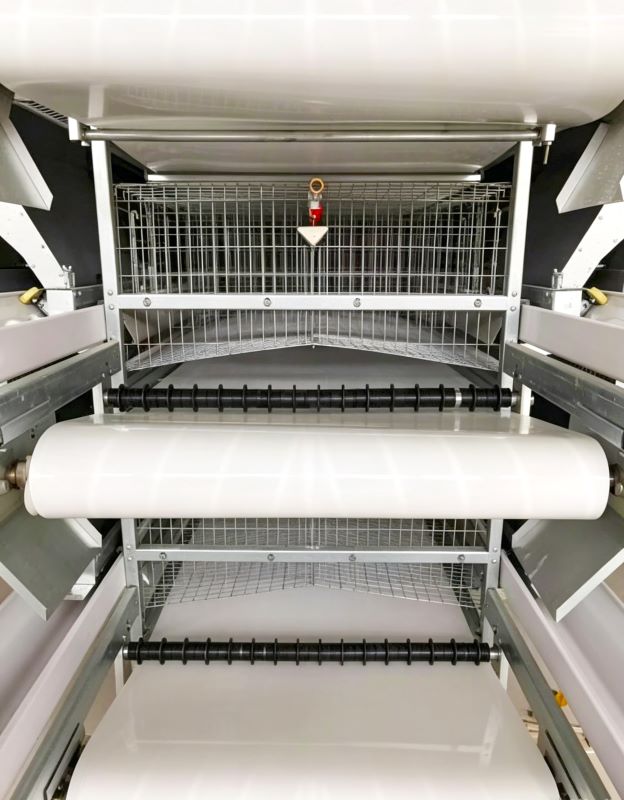
Manure Conveyor Belt Tracking Adjustment – Fix It Yourself Without a Service Call
Belt misalignment (tracking off) is a common issue in floor rearing houses. Most cases are caused by uneven tension, non‑parallel rollers, or uneven load distribution. Follow these three steps to fix it yourself. Step 1: Identify the direction and locationRun the belt empty and observe which side it shifts toward. If the belt runs to…
-
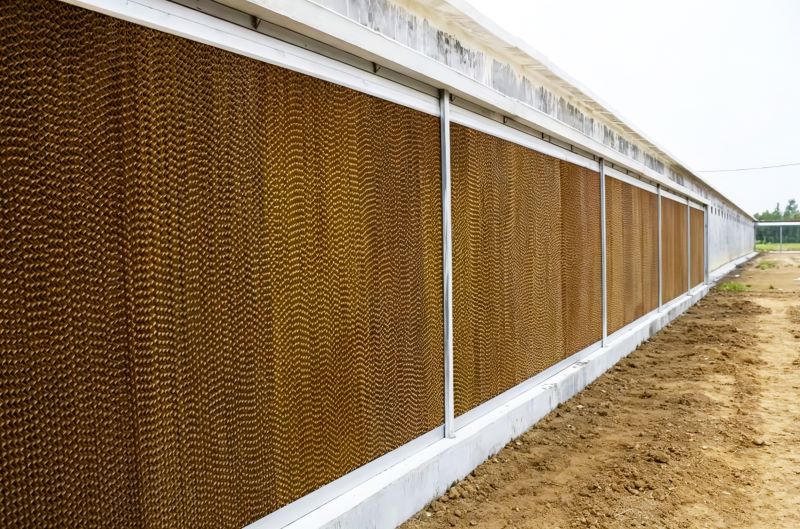
How to Calculate Cooling Pad Area Based on Fan Airflow in Poultry Houses
This article explains how to properly size evaporative cooling pad area based on tunnel ventilation fan airflow instead of house area, ensuring stable airflow and better cooling efficiency in poultry houses.
-
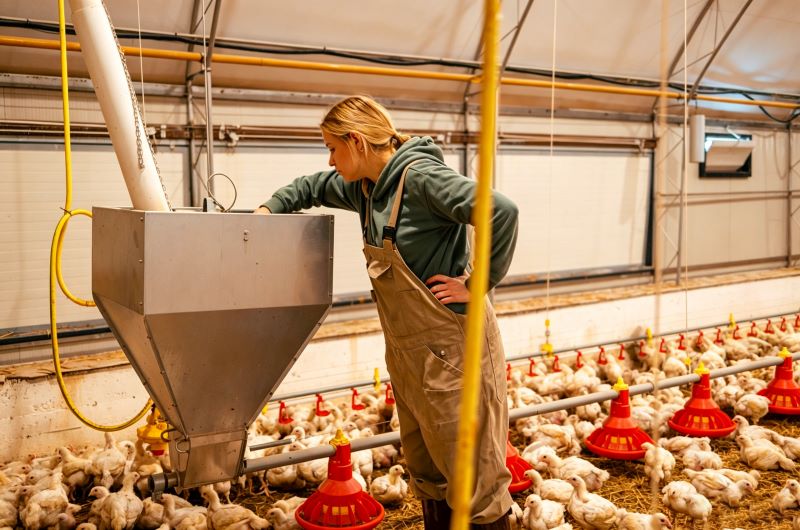
Automatic Poultry Feed Line Blocking Problems: 6 Common Causes and Troubleshooting Solutions
Automatic feeding systems are widely used in modern poultry farms to improve feeding efficiency and reduce labor dependency. However, feed line blockage can interrupt feeding operations and affect farm productivity. This article analyzes six common causes of automatic poultry feed line blockage, including feed quality issues, material accumulation, mechanical component wear, improper installation, electrical problems,…
Product Categories
Subscribe To Product News
Leave your email address and receive our latest product updates