Your cart is currently empty!
+86 15863276370

Automatic feeding systems play an important role in modern poultry farming by improving feeding efficiency and reducing manual labor requirements. However, feed line blockage is a common operational issue that may affect feeding continuity and farm management efficiency. Understanding the main causes and troubleshooting methods can help farmers maintain stable system performance.
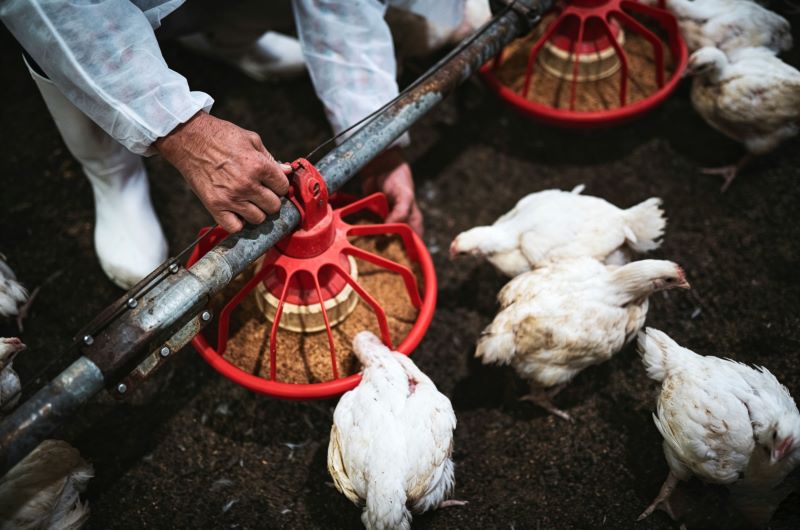
- Incorrect Feed Quality or Excessive Moisture
Feed with high moisture content, poor flowability, or improper particle size may increase the risk of blockage inside the feeding pipe or auger system. Selecting suitable feed characteristics and maintaining proper storage conditions can improve transportation efficiency. - Excessive Feed Accumulation in the System
When feed remains in the pipeline for long periods or the system is overloaded, material flow may become unstable. Regular inspection and proper feeding schedule management help prevent accumulation problems. - Damaged or Worn Conveyor Components
Augers, drive units, and other mechanical parts may affect feed movement when they become worn or damaged. Routine maintenance and timely replacement of key components are important for reliable operation. - Improper Installation or Alignment
Incorrect installation angles, pipeline deformation, or insufficient support points can create resistance during feed transportation. Checking the installation condition helps maintain smooth operation. - Motor or Power Supply Problems
Unstable power supply, motor overload, or incorrect electrical settings may cause the feeding system to stop unexpectedly. Electrical inspection should be included in regular maintenance procedures. - Foreign Objects Inside the Feed Line
Small foreign materials entering the feeding system may block the pipeline or damage internal components. Proper feed management and regular cleaning reduce this risk.
A reliable automatic poultry feeding system requires not only quality equipment but also correct installation, regular maintenance, and proper operation. By identifying the root cause of feed blockage, poultry farms can reduce downtime and maintain more stable feeding performance.
Share this:
Other Posts
-
Semi-Automatic vs. Fully Automatic Poultry Farming Systems: ROI Comparison and Investment Guide
Choosing between a semi-automatic and fully automatic poultry farming system is an important investment decision. The right solution depends not only on equipment cost, but also on farm capacity, labor availability, management requirements, and long-term operating expenses.
-
Empirical Estimation of 50% Labor Cost Reduction: A Cost-Saving Model for Automated Feeding in a 10,000-Bird Broiler Farm
This study quantifies labor cost savings from switching to automated feeding in a 10,000-bird broiler farm. Manual feeding requires two full-time workers for feed bag handling, transport, and daily distribution. Annual labor costs include wages (15/hour×8h/day×365days×2workers=15/hour×8h/day×365days×2workers=87,600), plus benefits, recruitment, and training overhead (estimated 25% of wages, 21,900)andmanagementsupervision(21,900)andmanagementsupervision(5,000). Total manual feeding cost: $114,500. Automated feeding uses a…
-
Precision Feeding Mechanism Using Sensors to Monitor Pan Feed Levels
Precision feeding relies on real‑time monitoring of feed remaining in pans. Load cells or infrared sensors placed under each pan continuously measure feed weight or fill height. When the measured level drops below a preset threshold, the controller activates the auger or chain feeder to deliver a small, measured amount of feed. This closed‑loop mechanism…
-
Poultry House Cooling Sequence During Extreme Heat: When to Start Tunnel Fans and Evaporative Cooling Pads
Extreme heat requires a coordinated cooling strategy in poultry houses. A staged approach generally begins with increased tunnel ventilation to remove accumulated heat and improve air movement. Evaporative cooling pads can then be introduced when ventilation alone is insufficient, provided that humidity and airflow conditions are suitable. During severe heat, fans and cooling pads can…
Product Categories
Subscribe To Product News
Leave your email address and receive our latest product updates