Your cart is currently empty!
+86 15863276370

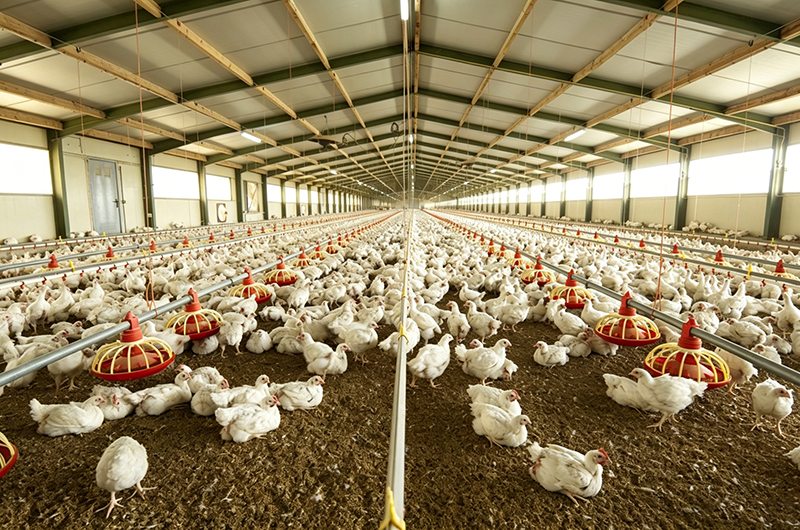
Ventilation system selection is one of the most important factors affecting environmental control efficiency in modern poultry houses. Different house structures, climate conditions, and production scales require different airflow strategies. Among commercial poultry ventilation solutions, tunnel ventilation and longitudinal ventilation are two widely applied systems.
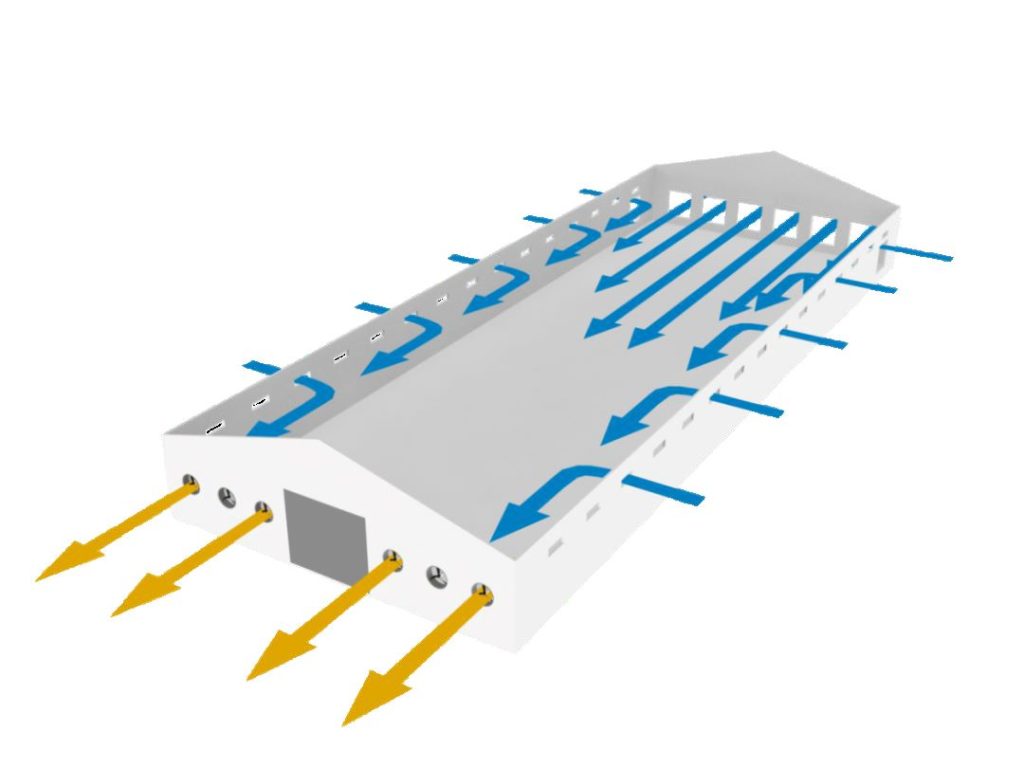
Tunnel ventilation works by introducing fresh air from one end of the poultry house and exhausting warm air through the opposite end. This creates a high-speed and relatively uniform airflow across the entire house. During hot weather conditions, the increased air movement improves the birds’ cooling sensation and helps reduce heat stress pressure. For high-temperature periods above 28°C, maintaining sufficient airflow velocity, commonly around or above 2.5 m/s under appropriate conditions, can improve thermal comfort when combined with proper cooling systems.
Longitudinal ventilation uses a similar airflow direction along the length of the poultry house but is often designed for houses with different width-to-length ratios or moderate climate conditions. It focuses on maintaining consistent air exchange, controlling humidity, and removing harmful gases such as ammonia.
The choice between these systems depends on several structural factors. Long and narrow poultry houses generally achieve better performance with tunnel ventilation because the airflow distance supports stable air speed. Wider houses or facilities located in moderate climates may benefit from longitudinal ventilation combined with optimized fan placement and air inlet design.
Other factors, including building insulation, fan capacity, cooling pad configuration, stocking density, and local weather conditions, also influence ventilation performance. Therefore, ventilation design should be based on a complete environmental control assessment rather than selecting equipment alone.
By matching airflow systems with poultry house structure and climate requirements, farms can improve temperature stability, enhance energy efficiency, and create a more suitable production environment for broiler growth.
Share this:
Other Posts
-
Precision Feeding Mechanism Using Sensors to Monitor Pan Feed Levels
Precision feeding relies on real‑time monitoring of feed remaining in pans. Load cells or infrared sensors placed under each pan continuously measure feed weight or fill height. When the measured level drops below a preset threshold, the controller activates the auger or chain feeder to deliver a small, measured amount of feed. This closed‑loop mechanism…
-
How to Choose Your Poultry System
How to Choose the Right Poultry Farming System and Equipment Selecting the right farming method and equipment starts with evaluating your farm scale, climate conditions, and target market. Floor rearing is suitable for welfare-focused farms, offering lower initial investment, easier all-in/all-out sanitation management, and relatively simple litter handling. Cage systems maximize stocking density but face…
-
Empirical Estimation of 50% Labor Cost Reduction: A Cost-Saving Model for Automated Feeding in a 10,000-Bird Broiler Farm
This study quantifies labor cost savings from switching to automated feeding in a 10,000-bird broiler farm. Manual feeding requires two full-time workers for feed bag handling, transport, and daily distribution. Annual labor costs include wages (15/hour×8h/day×365days×2workers=15/hour×8h/day×365days×2workers=87,600), plus benefits, recruitment, and training overhead (estimated 25% of wages, 21,900)andmanagementsupervision(21,900)andmanagementsupervision(5,000). Total manual feeding cost: $114,500. Automated feeding uses a…
-
Modern Poultry Farming Equipment: 2026 Global Trends & Market Growth
Explore how modern poultry farming equipment transforms broiler farms. Automated feeding, AI monitoring, EU cage ban, and market forecast to 2030. Read more.
Product Categories
Subscribe To Product News
Leave your email address and receive our latest product updates