Your cart is currently empty!
+86 15863276370

Climate variability associated with El Niño can create warmer or more humid conditions in some regions. For poultry farms, these environmental changes may increase the difficulty of managing manure moisture, ammonia emissions, and odor, particularly when ventilation and waste handling are not properly coordinated.
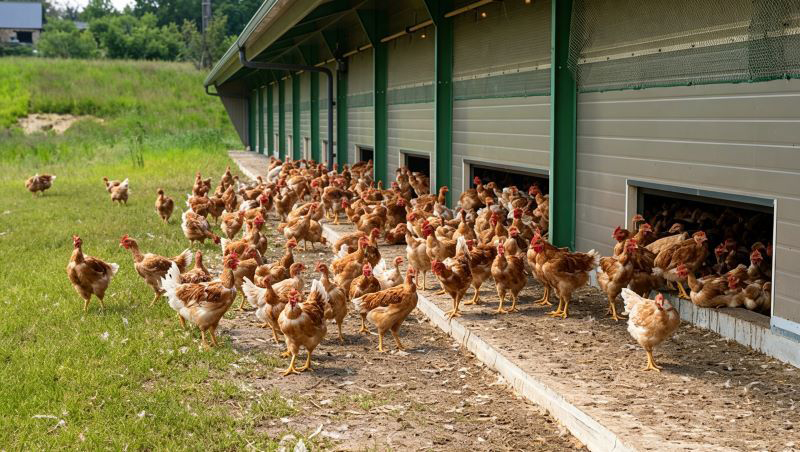
Ammonia is mainly produced when nitrogen-containing compounds in poultry manure are decomposed. Higher manure moisture and temperature can influence this process, while insufficient ventilation may allow ammonia concentrations to increase inside or around poultry housing.
Frequent manure removal is one practical management strategy. Manure belts or other automated removal systems can shorten the time manure remains inside the poultry house, helping improve waste-handling efficiency. The appropriate cleaning frequency should be determined according to manure moisture, flock size, house design, and local conditions.
Ventilation management is equally important. Adequate airflow helps remove moisture and gases from the house, while poorly managed ventilation can increase environmental problems. Odor-control equipment, including suitable air treatment or biofilter systems, may provide additional support where local conditions require it.
Biological odor-control products may also be considered, but their effectiveness can vary with temperature, moisture, application method, and manure characteristics. Farms should evaluate such products through site-specific testing rather than assuming identical results across different regions.
Overall, effective ammonia management requires a combination of manure removal, ventilation, moisture control, and appropriate odor-treatment measures. Climate conditions should be considered when developing seasonal waste-management plans.
Share this:
Other Posts
-
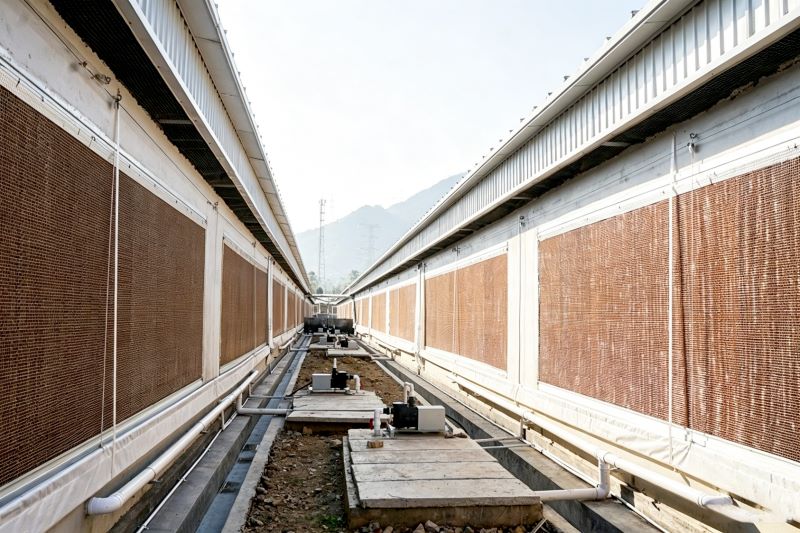
Synergistic Optimization of Cooling Pad Expansion and Water Quality Management: Strategies for Improving Evaporative Cooling Efficiency in Hot and Humid Regions
In tunnel-ventilated poultry houses, evaporative cooling pad performance directly impacts bird welfare and productivity during summer. Two critical factors determine system effectiveness: proper pad sizing and water quality management. Pad Sizing Principles Pad area should be determined by total tunnel fan capacity, not house dimensions. Industry standard recommends one square foot of six-inch pad for…
-
Development and Application of THI Early Warning Model: A Risk-Graded Alert Mechanism for Heat Stress Based on THI Thresholds
Heat stress in poultry is closely linked to temperature-humidity index (THI). A THI-based early warning model enables farms to act before birds suffer. The model defines four risk levels: THI < 74 (safe), 74–78 (caution), 79–83 (danger), and > 83 (emergency). Each threshold triggers specific actions—from increasing ventilation to activating cooling pads and adjusting feed…
-
Annual Feed Savings Estimation for a 10,000-Bird Broiler Farm Using Precision Feeding
Precision feeding delivers exact feed amounts based on real-time bird weight and intake patterns, minimizing waste. For a 10,000-bird flock with a 40-day cycle and average feed conversion ratio (FCR) of 1.6, total feed consumption reaches roughly 16,000 kg per cycle. Manual feeding typically wastes 5–10% of feed due to spillage, spoilage, and uneven distribution.…
-
A New Era of Human‑Machine Collaboration: Challenges and Solutions for Deploying AI Decision Systems in Floor‑Rearing Farms
Deploying AI decision systems in floor‑rearing farms promises improved efficiency but faces practical hurdles. Three major challenges emerge: data infrastructure gaps, worker acceptance, and system maintenance cost. Many farms lack reliable sensors or stable internet, leading to incomplete data. Workers, accustomed to manual observation, often distrust AI recommendations. Solutions include phased deployment starting with basic…
Product Categories
Subscribe To Product News
Leave your email address and receive our latest product updates