Your cart is currently empty!
+86 15863276370

Effective poultry house cooling requires more than a single piece of equipment. An integrated system can combine exhaust fans, evaporative cooling pads, fogging equipment, temperature and humidity sensors, and an environmental controller to respond to changing climate conditions.
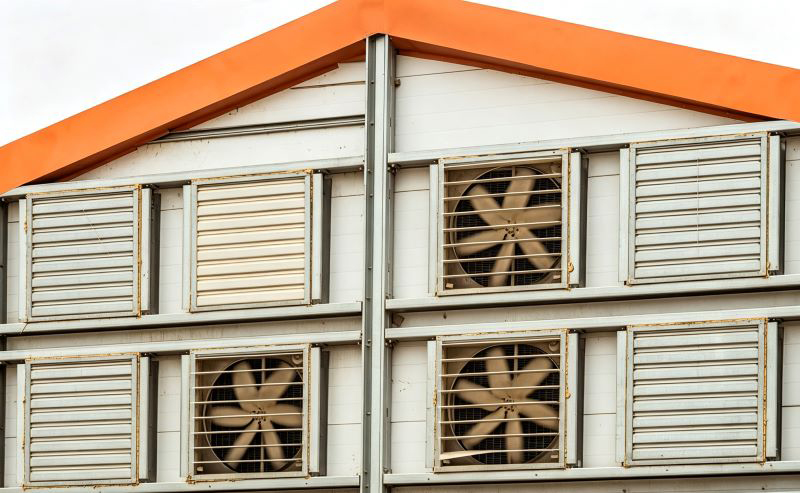
The first step is to establish sufficient airflow. Fans remove hot air and improve air movement inside the house. Cooling pads can then reduce incoming air temperature through evaporative cooling. Fogging systems may provide additional cooling when environmental conditions are suitable, but their effectiveness depends strongly on humidity and ventilation capacity.
System configuration should also match the local climate. In dry and hot regions, evaporative cooling can be particularly useful because lower humidity generally provides greater evaporation potential. In hot and humid climates, excessive water application may provide limited additional cooling, making ventilation capacity and humidity control more important.
Smart controllers can integrate sensor data and automatically adjust fan stages, cooling pads, and fogging according to preset operating conditions. This reduces reliance on fixed schedules and allows the system to respond more dynamically to temperature changes.
From an investment perspective, ROI should consider equipment cost, electricity and water consumption, maintenance, labor requirements, production objectives, and local climate. A higher initial investment may be reasonable when the system provides better environmental control and operational efficiency over its service life.
The most effective cooling solution is therefore not necessarily the system with the most equipment, but the one correctly matched to the poultry house, climate, and production requirements.
Share this:
Other Posts
-
Reducing Floor Egg Rate in Poultry Farming: Nest Box Selection and Management Strategy for Performance Optimization
Floor egg rate is an important performance indicator in layer poultry production, directly affecting egg collection efficiency, hygiene control, and overall farm profitability. In commercial operations, reducing floor eggs from 8% to 2% requires both proper nest box selection and systematic management strategies. Nest box design is the first critical factor. Appropriate size, entrance height,…
-
EU’s 2027 Cage Ban: How Long Will the Policy-Driven Boom for Floor Rearing Equipment Last?
The EU will ban conventional cages for laying hens and broilers by 2027. This regulation forces farms to switch to cage‑free systems, primarily floor rearing and aviaries. Consequently, demand for floor rearing equipment—feeders, drinkers, litter management, and ventilation—has surged. Market analysts estimate that the transition affects over 300 million hens in Europe alone. Replacement cycle…
-
Tunnel Ventilation vs Longitudinal Ventilation in Poultry Houses: How to Select the Right Airflow System for Different Farm Designs
Ventilation system selection is one of the most important factors affecting environmental control efficiency in modern poultry houses. Different house structures, climate conditions, and production scales require different airflow strategies. Among commercial poultry ventilation solutions, tunnel ventilation and longitudinal ventilation are two widely applied systems. Tunnel ventilation works by introducing fresh air from one end…
-
What Scale Makes Automation Most Cost-Effective? A Study on the Size Threshold for Floor Rearing Equipment Payback
For floor rearing farms, automation becomes cost-effective when scale passes a certain threshold. Using a 12–24 month payback benchmark, analysis shows that 10,000 birds per house is the minimum viable scale for automated feeding systems. Below 8,000 birds, labor savings do not offset equipment costs. At 15,000–20,000 birds, payback drops to 12–18 months, and automated ventilation becomes…
Product Categories
Subscribe To Product News
Leave your email address and receive our latest product updates