Your cart is currently empty!
+86 15863276370

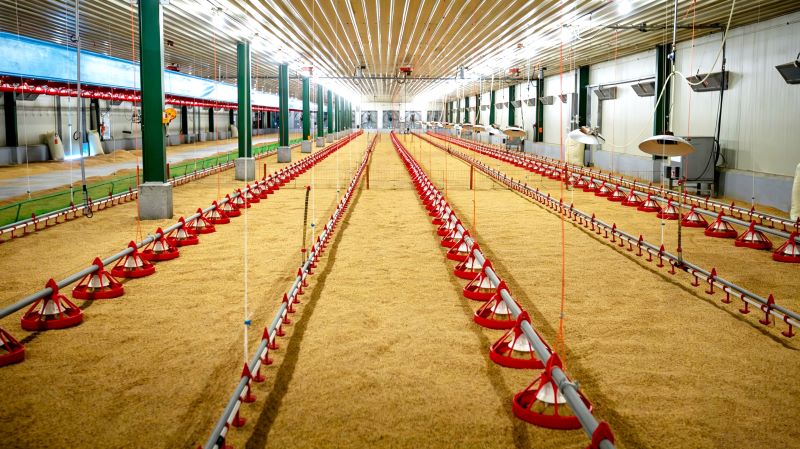
For floor rearing farms, automation becomes cost-effective when scale passes a certain threshold. Using a 12–24 month payback benchmark, analysis shows that 10,000 birds per house is the minimum viable scale for automated feeding systems. Below 8,000 birds, labor savings do not offset equipment costs.
At 15,000–20,000 birds, payback drops to 12–18 months, and automated ventilation becomes similarly viable. For smaller farms (5,000–8,000 birds), partial automation—such as pan feeders without silos—offers better returns.
Therefore, farms with ≥10,000 birds per batch should prioritize full automation. Below that, targeted semi‑automation is more economical. Scaling up by combining two small houses into one larger house can unlock automation benefits.
Share this:
Other Posts
-
Empirical Analysis of the Effect of Sealed Feed Bins on Feed Mold Control
Feed mold contamination is a major concern in poultry farming, leading to nutrient loss and health risks. This study evaluates the effectiveness of sealed feed bins in controlling mold development under practical farm conditions. A comparative trial was conducted over 90 days in two identical broiler houses. House A used conventional open feed storage, while…
-
Poultry House Orientation and Heat Stress Reduction: East–West vs North–South Layout Impact on Solar Heat Gain
Poultry house orientation is a fundamental design parameter that directly affects thermal comfort, ventilation efficiency, and broiler performance. In commercial poultry production systems, improper building orientation can significantly increase solar heat gain and raise the risk of heat stress, especially in hot climate regions. An east–west oriented poultry house is typically more exposed to direct…
-
Synergistic Design of Floor-Level Inlets and Ridge Outlets: An Airflow Optimization Scheme Combining Natural and Mechanical Ventilation
Effective ventilation is critical for poultry house air quality. This scheme integrates floor-level inlets with ridge outlets, blending natural and mechanical forces. Floor-level inlets, placed along side walls near the litter, allow fresh air to enter at bird level. Ridge outlets, installed at the roof peak, enable warm, stale air to rise naturally. During mild…
-
Equipment Depreciation and Technology Iteration: A Lifecycle Cost Analysis Model for Automated Floor Rearing Systems
Automated floor rearing systems require a lifecycle cost perspective beyond initial purchase price. Depreciation—spreading equipment cost over its usable life—and technology iteration—rapid upgrades in sensors, controls, and software—shape total ownership expense. A robust analysis model includes five phases: acquisition, installation, operation, maintenance, and residual value. Shorter technology cycles (e.g., every 3–5 years) accelerate depreciation but…
Product Categories
Subscribe To Product News
Leave your email address and receive our latest product updates