Your cart is currently empty!
+86 15863276370

Proper sizing of evaporative cooling pads is a critical factor in maintaining effective environmental control in modern poultry houses. Instead of relying on building area alone, the cooling pad surface area should be calculated based on the total airflow capacity of tunnel ventilation fans.
In tunnel-ventilated poultry systems, air velocity through the cooling pad is a key design parameter. A commonly recommended design standard is approximately 350 feet per minute (ft/min) across the pad surface. This ensures sufficient air exchange while maintaining effective evaporative cooling performance.
When the cooling pad area is undersized, air velocity increases beyond the optimal range. This leads to higher static pressure inside the house, reduced fan efficiency, and a significant drop in overall airflow rate. As a result, the evaporative cooling effect becomes weaker, and indoor temperature control may be compromised, especially during hot weather conditions.
Conversely, properly matched cooling pad area helps maintain balanced system resistance, stable airflow, and efficient heat removal. The design should always be coordinated with total fan capacity, ensuring that air entering the house is evenly distributed and effectively cooled.
Therefore, the correct engineering approach is to size cooling pads based on total tunnel fan airflow (m³/h or CFM) rather than poultry house floor area. This system-based calculation improves thermal comfort, reduces heat stress in broilers, and enhances overall production efficiency.
In modern poultry engineering, integrating ventilation and cooling pad design is essential for achieving stable environmental control and optimal bird performance.
Share this:
Other Posts
-
ROI Analysis of Precision Feeding Systems in Poultry Farming: How Smart Feeding Improves Feed Efficiency and Operational Performance
Precision feeding systems are becoming increasingly important in modern poultry production as farms seek better feed efficiency and more standardized management. This article analyzes the investment value of precision feeding technology by examining its impact on feeding accuracy, feed utilization, labor requirements, and operational efficiency. The ROI of such systems depends on factors including farm…
-
Empirical Estimation of 50% Labor Cost Reduction: A Cost-Saving Model for Automated Feeding in a 10,000-Bird Broiler Farm
This study quantifies labor cost savings from switching to automated feeding in a 10,000-bird broiler farm. Manual feeding requires two full-time workers for feed bag handling, transport, and daily distribution. Annual labor costs include wages (15/hour×8h/day×365days×2workers=15/hour×8h/day×365days×2workers=87,600), plus benefits, recruitment, and training overhead (estimated 25% of wages, 21,900)andmanagementsupervision(21,900)andmanagementsupervision(5,000). Total manual feeding cost: $114,500. Automated feeding uses a…
-
How Variable-Speed Poultry Fans Reduce Energy Use Without Compromising Cooling Performance
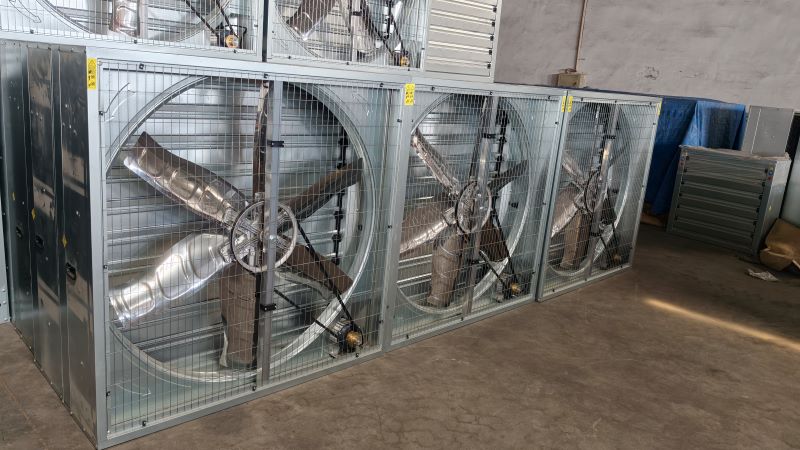
Variable-speed poultry fans can help farms balance cooling performance and electricity consumption by adjusting airflow according to environmental conditions. Instead of operating continuously at full speed, fans can run at lower speeds during moderate conditions and increase capacity when temperatures rise. When integrated with temperature sensors, evaporative cooling pads, and climate-control systems, variable-speed ventilation can…
-
Precision Feeding Mechanism Using Sensors to Monitor Pan Feed Levels
Precision feeding relies on real‑time monitoring of feed remaining in pans. Load cells or infrared sensors placed under each pan continuously measure feed weight or fill height. When the measured level drops below a preset threshold, the controller activates the auger or chain feeder to deliver a small, measured amount of feed. This closed‑loop mechanism…
Product Categories
Subscribe To Product News
Leave your email address and receive our latest product updates