Your cart is currently empty!
+86 15863276370

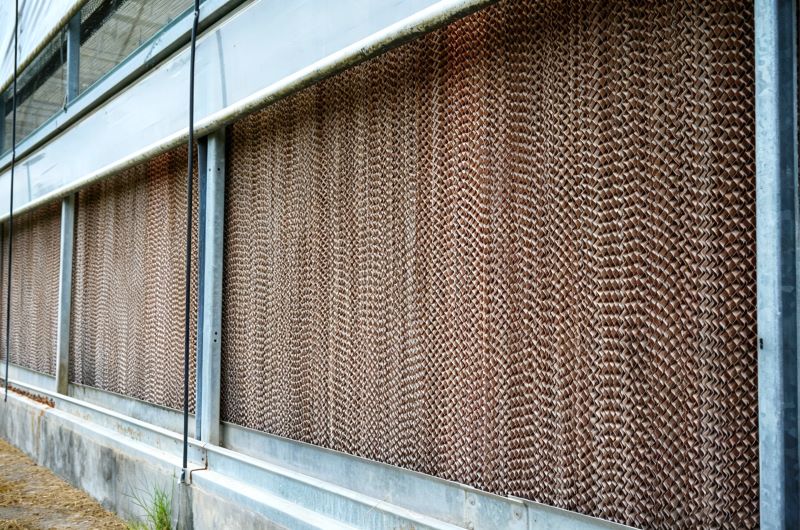
Evaporative cooling pads are widely used in modern poultry houses to reduce heat stress during hot weather. However, some farms experience limited cooling performance even when cooling pad systems are installed. Understanding the causes of reduced efficiency is essential for improving environmental control and maintaining stable production conditions.
One common reason is insufficient airflow management. Cooling pads rely on proper air movement through the wet surface to achieve effective evaporation. If fan capacity is inadequate, air leakage exists, or ventilation design is not optimized, the cooling effect inside the poultry house may be significantly reduced.
Another important factor is cooling pad condition and maintenance. Dust accumulation, mineral deposits, uneven water distribution, or aging pad materials can reduce water absorption and evaporation efficiency. Regular inspection and cleaning help maintain stable cooling performance.
Water quality and circulation systems also influence cooling efficiency. High mineral content water may cause scaling on the pad surface, reducing air contact with the wet material. A properly designed water supply system with filtration and regular maintenance can improve long-term reliability.
Poultry house structure and environmental conditions should also be considered. Poor insulation, excessive heat entering through roofs or sidewalls, and incorrect air inlet design can increase heat load and reduce the overall impact of cooling systems.
Optimizing evaporative cooling performance requires a combination of equipment selection, ventilation design, maintenance practices, and environmental management. By identifying the limiting factors, poultry producers can improve cooling efficiency, reduce heat stress risks, and create a more stable climate environment for broiler production.
Share this:
Other Posts
-
Quantified Effect of Dynamic Feed Adjustment on Feed Conversion Ratio Optimization
This study quantifies how dynamic feed adjustment improves feed conversion ratio (FCR) in broiler production. Dynamic adjustment tailors daily feed amounts to match real-time bird weight and intake patterns, unlike fixed feeding schedules. A 35-day trial on 10,000 Ross 308 broilers compared dynamic adjustment (sensor‑based, every 2–4 hours) with conventional fixed feeding. Results showed that…
-
Empirical Analysis of the Effect of Sealed Feed Bins on Feed Mold Control
Feed mold contamination is a major concern in poultry farming, leading to nutrient loss and health risks. This study evaluates the effectiveness of sealed feed bins in controlling mold development under practical farm conditions. A comparative trial was conducted over 90 days in two identical broiler houses. House A used conventional open feed storage, while…
-
Predictive Climate Control in Poultry Farming: Using Weather Forecast Data to Reduce Heat Stress Risks
Heat stress management is one of the most important challenges in modern poultry production, especially in regions experiencing frequent extreme temperature events. Traditional environmental control systems mainly respond after temperature changes occur, while predictive climate control combines weather forecast data with automated equipment management to improve farm preparedness. A predictive control model uses external weather…
-
Poultry Farming Equipment Industry Ushers in Intelligent Upgrade Wave, Market Size Expected to Exceed 20 Billion Yuan in 2025
With the deep application of technologies such as the Internet of Things and artificial intelligence, the poultry farming equipment industry is undergoing an unprecedented intelligent transformation. According to the latest market data, China’s poultry farming equipment market size is expected to exceed 20 billion yuan in 2025, with a compound annual growth rate of 12.26%.…
Product Categories
Subscribe To Product News
Leave your email address and receive our latest product updates