Your cart is currently empty!
+86 15863276370

Feed mold contamination is a major concern in poultry farming, leading to nutrient loss and health risks. This study evaluates the effectiveness of sealed feed bins in controlling mold development under practical farm conditions.
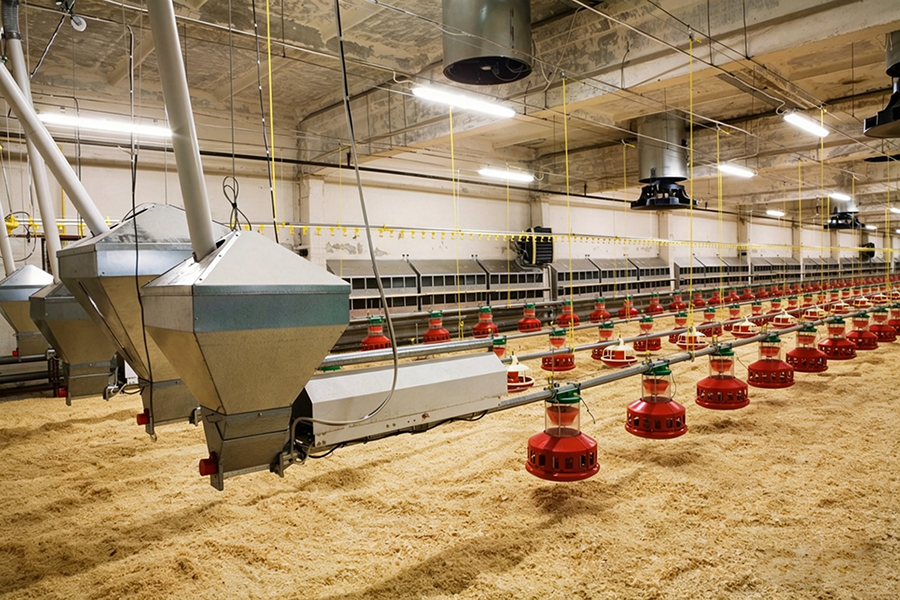
A comparative trial was conducted over 90 days in two identical broiler houses. House A used conventional open feed storage, while House B was equipped with airtight sealed feed bins. Feed samples were collected weekly from both systems and analyzed for moisture content and mold colony count.
Results showed that feed stored in sealed bins maintained significantly lower moisture levels (11.2% ± 0.3%) compared to open storage (13.8% ± 0.5%). Mold counts in sealed bins averaged 1.2 × 10³ CFU/g, well below the safety threshold, whereas open storage exceeded 4.5 × 10⁴ CFU/g after 60 days.
These findings confirm that sealed feed bins effectively reduce moisture ingress and inhibit mold proliferation, thereby preserving feed quality and reducing health risks. Investment in sealed bins is a practical intervention for modern poultry operations aiming to enhance feed safety and farm productivity.
Share this:
Other Posts
-
Heat Stress Management in Tropical and Subtropical Poultry Farms: Cooling Strategies, Feeding Adjustment, and Stocking Density Optimization
Heat stress is a major challenge for poultry production in tropical and subtropical regions, especially during periods of abnormal temperature increases. This article analyzes the effects of heat stress on broiler feed intake, growth performance, and farm management efficiency. It discusses practical strategies including evaporative cooling systems, ventilation improvement, stocking density adjustment, and feeding schedule…
-
Equipment Challenges in Hot and Humid Conditions: Technical Adaptations for Floor Rearing Systems in the Middle East
The Middle East challenges poultry farming with temperatures exceeding 50°C and high humidity. Standard floor rearing equipment requires significant adaptation. Ventilation demands oversized tunnel systems with high-capacity fans to maintain airspeed. Evaporative cooling pads need larger surface areas and regular maintenance to prevent mineral buildup. Drinking systems require higher-flow nipple drinkers for adequate hydration. Insulated…
-
Techno-Economic Assessment of Tunnel Ventilation Retrofitting: Pathways for Transitioning Conventional Houses to High-Airflow Systems
Conventional poultry houses often struggle with heat stress during summer, leading to reduced feed intake and higher mortality. Tunnel ventilation retrofitting offers a proven solution. The technical pathway involves installing high-capacity fans at one end, evaporative cooling pads at the opposite end, and sealing side inlets to create uniform 2–3 m/s airflow. This system lowers…
-
Poultry Farm Automation Trends: Why More Commercial Farms Are Adopting Automated Farming Systems
Poultry farm automation is becoming increasingly relevant as commercial farms seek greater efficiency, consistency, and better resource management. Automated feeding, drinking, ventilation, manure removal, and climate-control systems can reduce repetitive manual work and support more standardized daily operations. However, automation decisions should be based on farm scale, housing design, climate, production objectives, energy use, and…
Product Categories
Subscribe To Product News
Leave your email address and receive our latest product updates