Your cart is currently empty!
+86 15863276370

This study quantifies how dynamic feed adjustment improves feed conversion ratio (FCR) in broiler production. Dynamic adjustment tailors daily feed amounts to match real-time bird weight and intake patterns, unlike fixed feeding schedules.
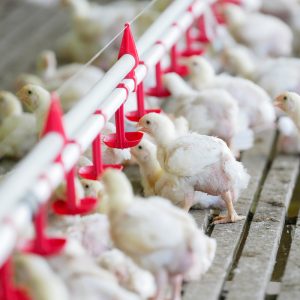
A 35-day trial on 10,000 Ross 308 broilers compared dynamic adjustment (sensor‑based, every 2–4 hours) with conventional fixed feeding. Results showed that dynamic adjustment reduced FCR from 1.64 to 1.51, an improvement of 0.13 (7.9%). Feed waste dropped from 8.2% to 2.2%, and final body weight increased from 1.85 kg to 2.05 kg.
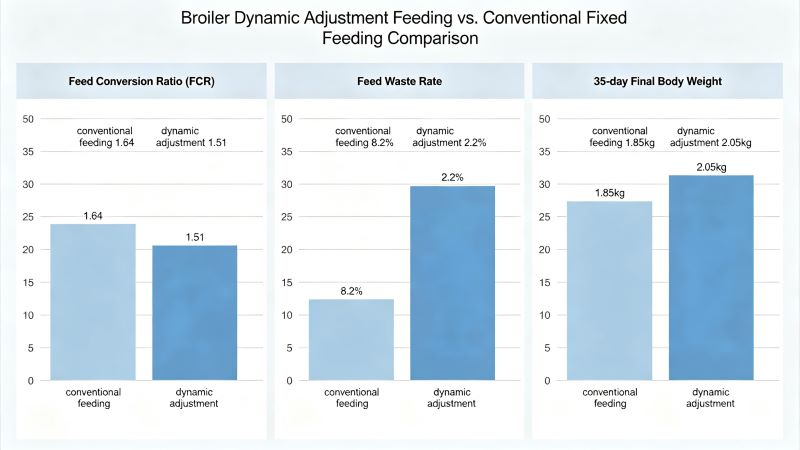
Regression analysis revealed that each 1% reduction in feed waste correlated with a 0.018 improvement in FCR. The precision of dynamic feeding reduced overfeeding during late stages and underfeeding during early growth. Consequently, FCR optimization directly lowers feed costs, which account for 60–70% of total production expenses. Dynamic adjustment offers a measurable, cost‑effective tool for broiler farms.
Share this:
Other Posts
-
Modern Poultry Farming Equipment: 2026 Global Trends & Market Growth
Explore how modern poultry farming equipment transforms broiler farms. Automated feeding, AI monitoring, EU cage ban, and market forecast to 2030. Read more.
-
Nighttime Feeding and Light Regulation Strategies: Behavioral Intervention to Avoid High-Temperature Periods and Impacts on Growth Performance
High ambient temperatures suppress feed intake in broilers, reducing growth and feed efficiency. Nighttime feeding combined with adjusted light schedules offers an effective solution. By shifting feeding to cooler evening and early morning hours, birds consume more feed when heat stress is minimal. A light regimen of 4 hours light, 2 hours dark during nighttime…
-
Development and Application of THI Early Warning Model: A Risk-Graded Alert Mechanism for Heat Stress Based on THI Thresholds
Heat stress in poultry is closely linked to temperature-humidity index (THI). A THI-based early warning model enables farms to act before birds suffer. The model defines four risk levels: THI < 74 (safe), 74–78 (caution), 79–83 (danger), and > 83 (emergency). Each threshold triggers specific actions—from increasing ventilation to activating cooling pads and adjusting feed…
-
Manual Feeding vs Precision Feeding Systems in Poultry Farming: Efficiency, Cost, and Feed Conversion Comparison
Feed management is one of the most critical factors affecting productivity and cost efficiency in poultry farming. Traditionally, manual feeding has been widely used due to its simplicity and low initial investment. However, with the development of automation technology, precision feeding systems are increasingly replacing manual operations in modern poultry houses. Manual feeding relies heavily…
Product Categories
Subscribe To Product News
Leave your email address and receive our latest product updates